

Write Enforceable Specs: 130kg Capacity and HSG57 for UK 24/7 Seating
Specify certified intensive-use seating, not standard 8-hour office chairs, for any environment running round-the-clock shifts. Your tender should reference HSE HSG57, require ANSI/BIFMA X5.1 or FNEW-style intensive-use test evidence, and ask suppliers to prove weight capacity, warranty terms and NHS or public-sector approval history before you sign anything.
TL;DR:
- Specify chairs that meet intensive-use standards such as ANSI/BIFMA X5.1 and FNEW-style testing, with proof of load capacity and cycle counts.
- Use hard numerical specifications for adjustments, weight ratings, and load capacity to ensure chairs are fit for multi-shift, round-the-clock environments.
- Conduct daily and quarterly maintenance focused on shared contact surfaces, mechanism functionality, and foam condition to prevent early failure.
- Require supplier documentation including test certificates, warranty terms, NHS-approved supply history, and evidence of compliance with HSE HSG57 and other standards.
- Choose supplier products already proven in institutional settings, with clear maintenance policies and comprehensive aftercare support aligned with continuous operation needs.
Table of Contents
- What makes a chair suitable for continuous, 24/7 seating requirements?
- Which UK standards and certifications should you specify?
- Which features and specification values matter for round-the-clock use?
- How should you clean and maintain seating used around the clock?
- What should your tender checklist and supplier questions cover?
- How does ALXR meet these procurement requirements?
- Get ALXR support for your 24/7 seating specification
- What actually matters when you specify continuous-use seating
- Sources
What makes a chair suitable for continuous, 24/7 seating requirements?
A chair built for a single person working eight hours a day is a different product to one built for three shifts and three different bodies across 24 hours. That distinction sits at the heart of every 24-hour seating standards discussion, and it’s the one most procurement documents get wrong. Standard office chairs are typically designed for 8-hour daily use, with mechanisms, foams and castors rated for one user’s weight and movement pattern repeated over a working week.
Intensive-use chairs are engineered against a completely different duty cycle: multiple users, constant weight-shifting, mechanisms cycling thousands of times more often than in a standard office. That drives real differences in construction:
- Reinforced gas lifts and synchro mechanisms rated for continuous cycling, not intermittent use
- Higher-density foams that resist compression set after years of 24-hour contact
- Heavy-duty bases and castors tested against dynamic load standards, not just static ones
- Upholstery chosen for abrasion resistance and repeated cleaning cycles
Underspecify here and the cost shows up later: premature mechanism failure, chairs that sag within eighteen months, and a health and safety file with no test evidence to defend against an HSE query. Getting this right protects your budget as much as your compliance position.
Which UK standards and certifications should you specify?
Your tender documents need to name specific standards, not vague phrases like “commercial grade.” HSE’s HSG57 guidance on seating at work is the starting reference point for any UK workplace specification. It sets out how seating should be selected, adjusted and reviewed to prevent musculoskeletal disorders, and referencing it explicitly in a tender gives your procurement team a defensible standard to hold suppliers against.
Beyond HSG57, ask for test evidence against recognised durability benchmarks:
- ANSI/BIFMA X5.1 as the baseline safety and durability standard most UK and European manufacturers test against
- FNEW-style intensive-use testing (or equivalent manufacturer data) covering higher cycle counts and load tests appropriate to round-the-clock operations, since ANSI/BIFMA alone was never designed for continuous multi-shift use
- BS EN 1335 references where the supplier can show compliance, alongside any FIRA-verified test reports
Request test evidence, not marketing claims. A supplier’s product sheet describing a chair as “heavy-duty” means nothing without cycle counts and load-test figures behind it. Ask for the actual test report, the load rating in kilograms, and the cycle count the mechanism was tested to.
Documents to request as standard: signed test certificates, warranty terms in writing, a maintenance and spares policy, and confirmation of any NHS or public-sector supply history that demonstrates the supplier already meets institutional procurement bars.
Which features and specification values matter for round-the-clock use?
Once the standards are settled, the specification needs hard numbers procurement can write into a contract. Vague terms like “adjustable” invite suppliers to interpret minimum compliance rather than genuine fitness for multi-shift use.
- Seat depth adjustment: a sliding range of at least 5 to 6cm to fit different leg lengths across users
- Independent back and lumbar adjustment: height and depth-adjustable lumbar support, separate from recline tension
- Recline ratio: synchro-tilt mechanisms with a ratio that keeps the seat pan roughly level as the back reclines, reducing pressure on the thighs
- Armrest adjustability: height and width adjustment as a minimum, with 4D armrests where control-room or clinical desks demand fine positioning
- Weight and load rating: a stated capacity of at least 130kg as standard, with bariatric options rated higher available on request
- Base and castors: reinforced five-leg or seven-leg bases with castors tested for continuous dynamic loading, not just the lighter static tests standard chairs pass
- Upholstery: cleanable, abrasion-rated fabric or vinyl that tolerates disinfectant wipe-downs between shifts
For shared seats, quick-adjust controls matter as much as the adjustment range itself: an operator changing shift at 6am needs to reset seat depth, lumbar and recline in seconds, not minutes. Security and emergency personnel wearing duty belts benefit from cutaway side profiles and width-adjustable arms that reduce wear on the chair and discomfort for the wearer.
Pro Tip: Specify a documented adjustment range in centimetres or kilograms, not adjectives. “Seat height 42 to 54cm” is enforceable in a contract. “Ergonomically adjustable” is not.
How should you clean and maintain seating used around the clock?
A chair running three shifts a day needs a maintenance schedule that matches its usage, not the annual once-over a standard office chair gets away with.
- Daily: wipe down armrests, seat and backrest with a disinfectant compatible with the upholstery, focusing on shared-contact surfaces between shift handovers
- Weekly: check castors for debris build-up and confirm gas lift and recline tension are still functioning smoothly
- Quarterly to annually: full mechanical inspection, including base stability and mechanism wear, with a spares plan agreed against the supplier’s warranty terms
- Replacement triggers: sagging foam, mechanism play, or cracked castors are your signal to budget for replacement rather than patch-repair, since delayed replacement in a 24/7 setting compounds musculoskeletal risk across every user on that seat
Budgeting total cost of ownership around these cycles, rather than purchase price alone, is what separates a genuinely sound procurement decision from a false saving.
What should your tender checklist and supplier questions cover?
A tender for continuous seating requirements should read like a compliance document, not a catalogue enquiry. Copy these lines directly into your specification:
- Signed test certificates against ANSI/BIFMA X5.1 and intensive-use or FNEW-equivalent testing
- Confirmed weight capacity in kilograms, with bariatric variants listed separately
- Written warranty terms, including what counts as fair wear versus a covered defect
- Installation and delivery timelines, including nationwide coverage if you’re procuring across multiple sites
- Evidence of NHS-approved supplier status or equivalent public-sector supply history
- A named spares and service contact, not a generic support inbox
- Reference to HSE HSG57 compliance in the supplier’s own product documentation
Ask suppliers directly: what cycle count was the mechanism tested to, what’s the expected lifespan under three-shift use, and what’s the total cost over five years including spares and any reupholstery. A supplier who can’t answer the third question hasn’t priced their product for the environment you’re buying it for.
How does ALXR meet these procurement requirements?
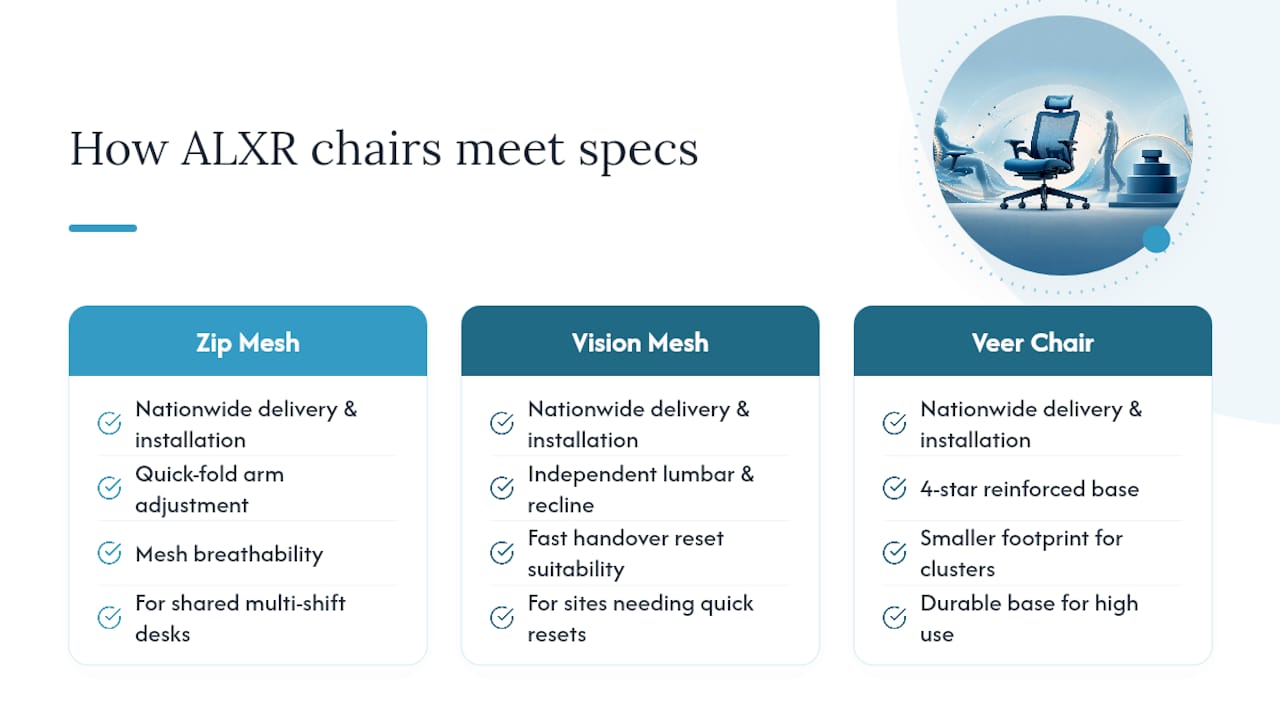
ALXR supplies as an NHS-approved provider, with nationwide delivery and installation built into every order, so procurement teams get the paperwork and the service continuity in one contract rather than two. The Zip Mesh Back Chair with Folding Arms offers the quick-fold arm adjustment and mesh breathability that suit shared, multi-shift desks. The Vision Mesh Office Chair brings independent lumbar and recline adjustment for sites needing fast handover resets. The Veer Chair with 4 Star Base suits compact workstation clusters where a smaller footprint still needs a durable, reinforced base. All three map directly onto the specification points above, backed by ALXR’s warranty programmes.
Get ALXR support for your 24/7 seating specification
Writing a compliant specification is only half the job. Sourcing, delivering and installing chairs across multiple sites without disrupting a live 24-hour operation is the other half, and it’s where ALXR’s nationwide delivery and installation network earns its place in your procurement plan.
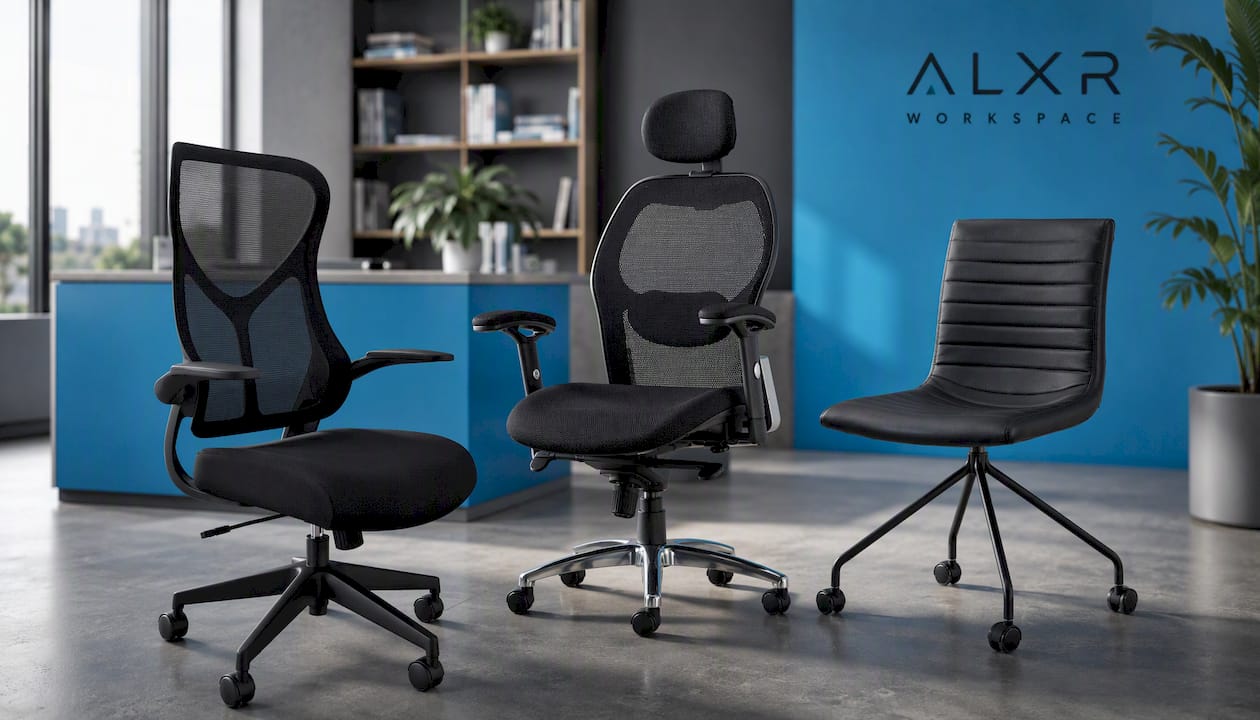
ALXR’s team supports procurement through the whole process: specification advice mapped to HSE HSG57 and intensive-use standards, site surveys for multi-shift layouts, delivery and installation scheduled around your operational hours, and warranty and aftercare that don’t disappear once the invoice is paid. As an NHS-approved supplier, ALXR already meets the documentation bar most public-sector tenders demand, which shortens your own approval cycle. Purchase orders and credit accounts are both available for organisational buyers, so finance teams aren’t stuck adapting their process to the supplier. Browse the Zip Mesh Back Chair range or the full ALXR Workspace catalogue to start building your specification with products that already meet the standards this article sets out.
What actually matters when you specify continuous-use seating
Most procurement failures on 24/7 seating aren’t caused by picking the wrong chair. They’re caused by writing a specification vague enough that any chair technically qualifies. A document that says “ergonomic and durable” lets a supplier tick the box with a standard office chair rebadged for shift work, and you won’t find out it was the wrong call until year two, when mechanisms start failing under load they were never tested for.
The fix isn’t complicated: name the standards, demand the test certificates, put adjustment ranges in centimetres rather than adjectives, and treat maintenance as a budget line rather than an afterthought. Do that, and supplier selection becomes straightforward rather than a gamble.
One-line checklist: reference HSG57, demand ANSI/BIFMA or FNEW test evidence, specify adjustment ranges numerically, confirm warranty and service terms, and choose a supplier who can prove institutional supply experience.
— Syed
Sources
- HSG57: Seating at work — HSE
- Why quality chairs are essential for 24/7 control room operations – ControlRooms
- Understanding differences between normal office chair standards and 24/7 chair standards — Concept Seating
- FIRA - BS EN 1335 resources