

£3–£6 Return per £1: Anti Fatigue Mat Benefits for Facilities Managers
Anti-fatigue mats reduce leg and lower-back fatigue, improve peripheral circulation and ease joint strain for people who stand for long periods, provided the mat’s material and density suit the environment. Peer-reviewed trials on surgical staff and broader ergonomics reviews back this up, and the workplace ROI case is strong once you factor in absence and productivity. An ergonomic furniture range can work alongside these mats as part of a fuller standing-workplace solution.
TL;DR:
- The most effective anti-fatigue mats are made from dense rubber or polyurethane and should be around 9–12 mm thick for office use or 12–16 mm for industrial environments.
- Mats work best in roles with prolonged, fixed standing, such as manufacturing, healthcare, or retail, reducing lower-limb discomfort by about 50–60 percent.
- Regular inspection and replacement are crucial, with foam mats lasting one to three years and rubber or polyurethane mats up to ten years under heavy use.
- Proper sizing, beveled edges, slip resistance, and resistance to chemicals are key specifications to prevent safety hazards and ensure longevity.
- Combining mats with ergonomic furniture, proper footwear, and scheduled microbreaks maximizes fatigue reduction and overall workspace comfort.
Table of Contents
- What are the core benefits of an anti-fatigue mat?
- How do anti-fatigue mats work, and what does the evidence say?
- Who benefits most from standing on an anti-fatigue mat?
- Which mat types and specifications actually matter?
- What’s the ROI case for employers?
- How do you maintain and replace anti-fatigue mats?
- Fitting mats into a wider ergonomic strategy
- Building a standing-friendly workspace with Alxr
- Sources
- FAQ
What are the core benefits of an anti-fatigue mat?
Standing on concrete or tiled floors for hours forces your calf and foot muscles into constant static tension. That static load is what an anti-fatigue mat is designed to interrupt, and the physiological payoff shows up in several measurable ways.
- Less leg, foot and lower-back fatigue — the surgical team crossover study found significantly lower reported pain and fatigue with a 15 mm rubber mat compared with a hard floor.
- Better peripheral circulation — the slight give in the mat keeps calf muscles working gently, which supports blood return from the lower legs and can reduce swelling.
- Lower joint compression — pressure spreads across a larger surface of the foot rather than concentrating on the heel and forefoot, easing strain through the knees and hips.
- Secondary gains — depending on the material, mats add thermal insulation against cold floors, slip resistance, and (for closed-cell types) easier hygiene control.
A checkout operative on an eight-hour shift, a standing-desk user rotating through the afternoon, and a scrub nurse in theatre for a four-hour procedure are solving the same biomechanical problem in different settings. Industry reviews suggest anti-fatigue mats can cut lower-limb discomfort and back strain by roughly 50–60% compared with standing directly on hard flooring in controlled studies. That is a meaningful reduction for the cost of a single mat.
How do anti-fatigue mats work, and what does the evidence say?
The mechanism is simpler than most product pages make it sound. A quality mat compresses slightly under your foot, which your nervous system detects as instability. You respond with tiny, constant postural adjustments, known as micro-instability, that keep your calf and foot muscles firing instead of locking into one static position. This is the “muscle pump” effect: the repeated micro-movement squeezes blood back up through the leg veins rather than letting it pool.
The 2023 crossover trial on operating theatre staff found significantly lower post-procedure pain and fatigue scores among those using a 15 mm rubber mat, a controlled result rather than an anecdotal one, and it’s a rare case of anti-fatigue mat research using a clinical trial design rather than a satisfaction survey.
Broader ergonomics literature reviews reach a similar conclusion: compliant standing surfaces, mats included, reduce discomfort and lower-limb complaints tied to prolonged standing. Mat density matters enormously here. Engineering assessments of matting performance show that cheap, overly soft foam can lose its supportive structure within months, at which point the muscle pump effect simply stops working. Mats are not a standalone fix, either. They work best alongside good footwear, sensible work design and regular microbreaks, not as a substitute for any of them.
Who benefits most from standing on an anti-fatigue mat?
The benefit scales directly with how long someone stands still in one spot. A worker who moves around a warehouse floor gets less from a mat than someone rooted at a single station for a full shift.
- Manufacturing and assembly lines — operators standing at a fixed station for six to eight hours see some of the clearest fatigue reductions.
- Retail tills and hospitality bars — repetitive standing with limited movement, often on hard commercial flooring.
- Commercial kitchens — chefs combine mats with slip resistance requirements around wet, greasy floors.
- Healthcare, particularly operating theatres — the surgical staff trial makes this one of the most persuasive use cases for employers, since procedures routinely run past two hours with no chance to step away.
- Standing-desk users — office workers alternating between sitting and standing benefit less dramatically than full-shift standers, but still notice reduced foot soreness by late afternoon.
Mats deliver the most value on multi-hour shifts. Pair them with proper footwear and scheduled breaks and the fatigue reduction compounds rather than plateaus.
Which mat types and specifications actually matter?
Material choice determines whether a mat holds up for years or turns into a tripping hazard within a season.
- Rubber and polyurethane — the standard for commercial and industrial floors; dense, durable, and resistant to oils and chemicals.
- Closed-cell foam — lighter and cheaper, suited to home offices or short-duration standing, but compresses faster under heavy daily use.
- Gel-topped mats — useful for specialised, low-traffic stations where pressure relief matters more than durability.
- Modular tiles — practical for large floor areas like production lines, since damaged sections can be swapped without replacing the whole run.
On thickness, product engineering guidance points to roughly 9–12 mm for office standing-desk mats using firmer foam or polyurethane, rising to 12–16 mm or more for industrial and commercial kitchen floors using dense rubber. Going thicker than that can actually introduce instability rather than comfort.
Before ordering a warehouse’s worth of matting, run a checklist: correct size for the workstation, bevelled edges to prevent trips, an appropriate anti-slip rating, chemical or oil resistance where relevant, HACCP compliance in food environments, and ease of cleaning.
Pro Tip: Trial your chosen mat specification at one workstation for a few weeks before ordering at scale. It costs little and catches sizing or slip-rating mistakes before they become an expensive site-wide mistake.
What’s the ROI case for employers?
The evidence for employees feeling less fatigued is solid. The financial case for employers follows logically from it, once absence and productivity enter the picture.
- Reduced reported fatigue and musculoskeletal complaints translate into fewer days lost to lower-back and leg strain, particularly in roles with fixed standing stations.
- Premium rubber or polyurethane mats cost more upfront than basic foam, but last considerably longer in busy environments, making them cheaper per year of use once you account for replacement cycles.
- Ergonomics programme case studies suggest returns in the region of £3 to £6 for every £1 spent, driven mainly by fewer injuries and steadier productivity through a shift.
The practical approach is a phased trial: fit mats at a handful of high-standing-time stations, monitor absence and comfort feedback for a quarter, then expand. Combining mats with height-adjustable desks and a sensible footwear policy tends to outperform any single intervention on its own.
How do you maintain and replace anti-fatigue mats?
Cleaning routines depend on material. Rubber and polyurethane mats wipe down and disinfect easily, holding up to daily commercial cleaning without degrading. Foam mats trap moisture more readily, which means they need more careful drying and more frequent inspection to avoid bacterial build-up.
- Check compression — if the mat has lost more than roughly 20% of its original thickness, it has stopped delivering the muscle-pump benefit and needs replacing.
- Inspect for cracking or curling edges — damaged bevels and worn anti-slip backing turn a safety feature into a trip hazard.
- Follow realistic lifespans — foam mats typically last one to three years under regular use; commercial rubber or polyurethane can run five to ten years or more depending on foot traffic.
Fitting mats into a wider ergonomic strategy
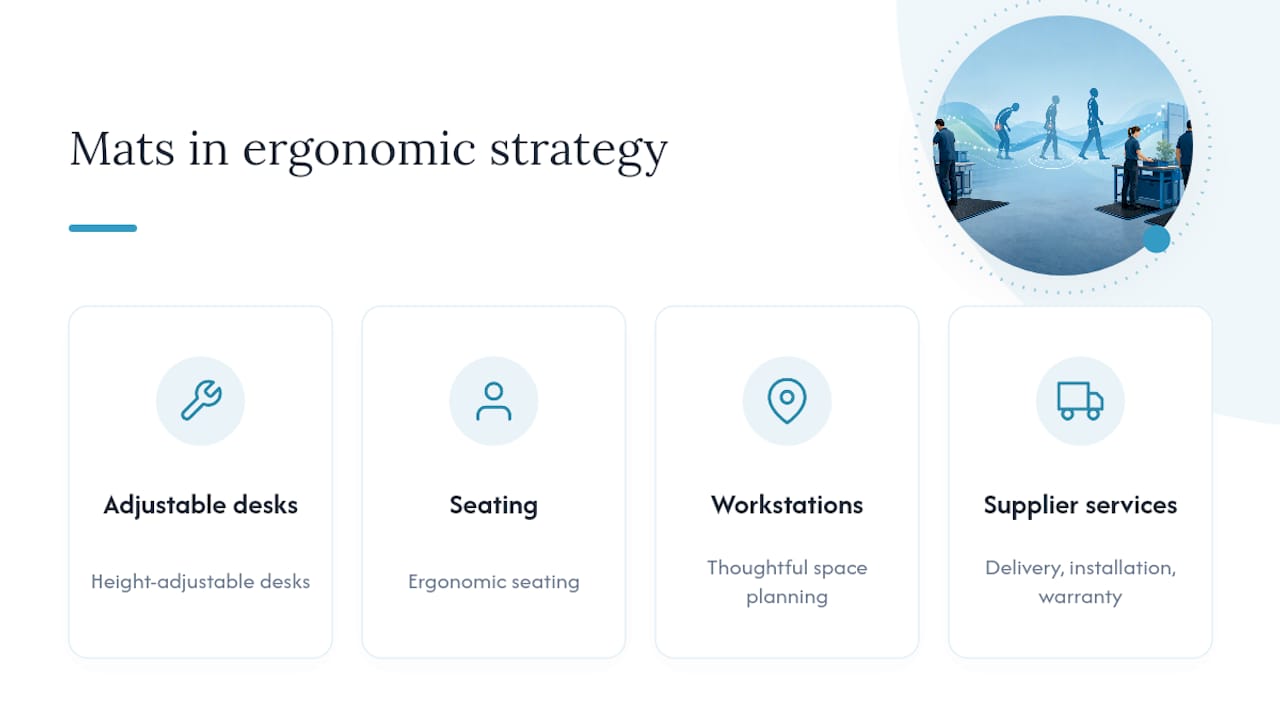
A mat solves one part of a standing job. It works best alongside height-adjustable desks, proper seating, and thoughtfully planned workstations rather than as an isolated fix. Some suppliers offer nationwide delivery and installation alongside space planning and warranty support, which means a mat rollout can sit inside a properly designed workspace from the outset rather than as an afterthought bolted onto existing furniture.
Building a standing-friendly workspace with Alxr
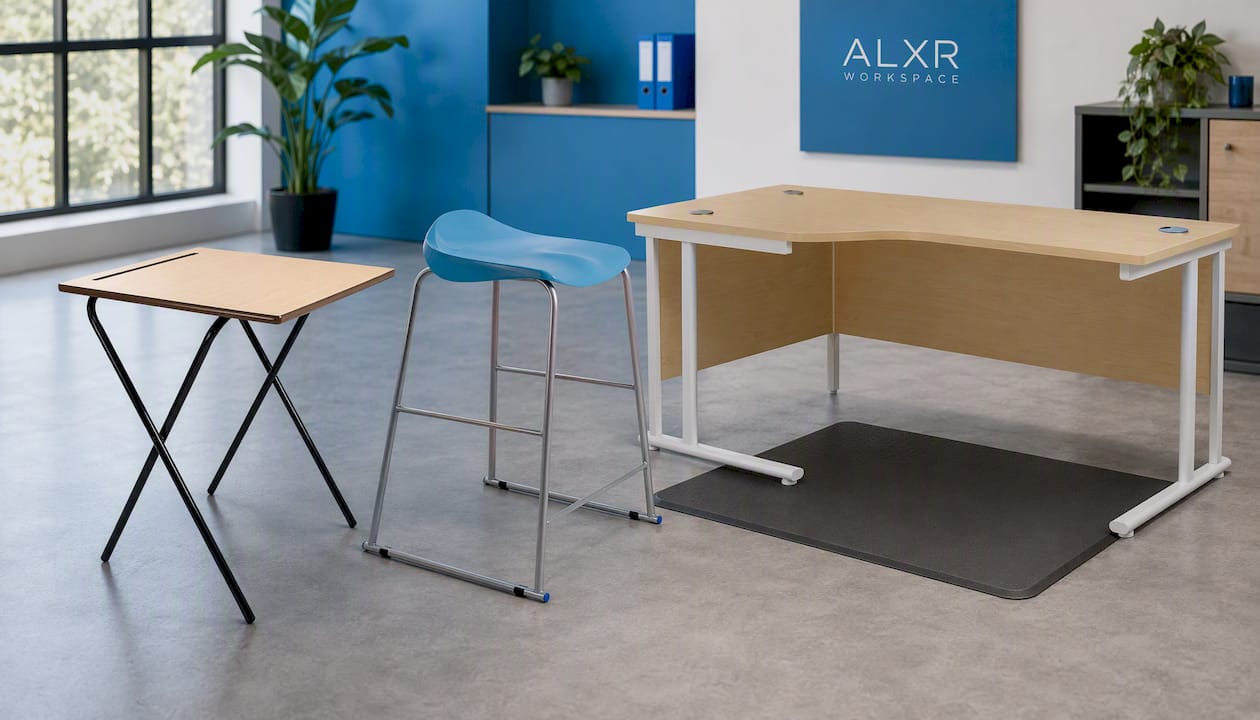
Mats handle the floor. The rest of the standing workstation still needs the right desk, the right stool for perch breaks, and furniture that’s actually built for shift-length use rather than a nine-to-five office. Alxr’s catalogue covers that gap directly: the Titan Premium Folding Exam Desk suits clinical and healthcare settings where space is tight and flexibility matters, the Titan Stool gives standing workers a proper perch option for short recovery breaks, and the Twin Upright Right Hand Radial Desk (FSC) pairs well with mat deployment in shared workstation layouts.
Beyond individual products, Alxr runs nationwide delivery and installation as standard, so a multi-site mat and furniture rollout doesn’t turn into a logistics headache for your facilities team. Space planning and design support are available for organisations reworking standing workstations at scale, backed by warranty cover on qualifying furniture. If you’re weighing up a phased trial across a few departments, get in touch through the Alxr workspace catalogue to arrange a site survey and see what a combined mat-and-furniture approach looks like for your floors.
Sources
Findings referenced above draw on the surgical staff crossover trial, ergonomics literature reviews, matting engineering reports, and occupational health guidance.
- The effect of anti-fatigue floor mat on pain and fatigue levels of surgical team members: A crossover study
- NIOSH / Ergonomics literature review resources
- The effect of COBA anti fatigue floor matting on worker comfort during standing work (report)
- Do Anti-Fatigue Mats Really Work? The Science & UK Guide 2026 – Rubber Co
FAQ
What is the purpose of an anti-fatigue mat?
An anti-fatigue mat reduces the static muscle strain that builds up when someone stands in one spot for long periods, using slight give in the material to keep leg muscles gently active. This supports circulation and reduces the fatigue and discomfort documented in studies on surgical staff standing for extended procedures.
How often do you need to replace anti-fatigue mats?
Foam mats typically need replacing every one to three years under regular use, while commercial rubber or polyurethane mats can last five to ten years or more depending on foot traffic.
Where do you put an anti-fatigue mat?
Place a mat directly at the fixed point where someone stands for extended periods, such as a checkout till, an assembly station, a kitchen prep area, or an operating table. Size and position it so the worker’s feet stay on the mat throughout the task, with bevelled edges to prevent tripping.
Are anti-fatigue mats good for your feet?
Yes, when the density and thickness suit the environment. They spread pressure across the foot rather than concentrating it on the heel, and ergonomics reviews link compliant standing surfaces to reduced lower-limb discomfort, though poorly specified or overly soft mats can fail to deliver that benefit over time.
Recommended
- Why Every Employer Should Invest in Height-Adjustable Desks
- Office Rectangular Single Motor Sit Stand Desk (FSC) | 1200X800 | Grey Oak/White
- Goal Post Rectangular Desk + 3 Drawer High Mobile Pedestal (FSC) | 1200x600 | White/White
- Office Rectangular Dual Motor Sit Stand Desk (FSC) | 1800X800 | Grey Oak/Black