

Evidence Backed Ergonomic Office Chair Benefits in Six Adjustments
An ergonomic office chair reliably improves posture and comfort, and can reduce certain kinds of musculoskeletal pain, though the pain evidence is more mixed than marketing suggests. Systematic reviews back the comfort claims consistently; pain relief varies by study and by person. A practical way to test that difference is available with trial-friendly, warrantied seating from an experienced supplier.
TL;DR:
- Properly fitted ergonomic chairs improve posture and spinal alignment mainly through adjustable seat height and depth, supporting the natural lumbar curve during long sittings.
- Comfort gains from ergonomic chairs are consistent, as they distribute pressure evenly and reduce pressure points, which lowers fatigue and minimizes micro-movements.
- Pain reduction is less reliably supported, since outcomes depend on individual fit, study design, and duration, with persistent pain needing additional treatment beyond seating.
- Chairs with multiple independent adjustments tend to offer real benefits over standard models, especially for those spending more than six hours daily at a desk.
- Investing in a high-quality chair with a trial, warranty, and proper setup can be cost-effective over time, as it reduces physical strain, discomfort, and associated productivity losses.
Table of Contents
- Ergonomic office chair benefits for posture and spinal alignment
- Reduction of back, neck and shoulder pain
- Comfort, pressure distribution and reduced fatigue
- Productivity, concentration and the economic case
- The adjustments that actually produce these benefits
- Why publisher expertise matters when you’re buying for health outcomes
- How to choose and trial an ergonomic office chair
- Circulation, movement and preventing musculoskeletal disorders
- Ergonomic chairs versus standard office chairs
- Is an ergonomic chair worth the cost?
- Practical perspective: realistic expectations and next steps
- Finding the right Alxr chair for how you actually work
- Sources
- FAQ
Ergonomic office chair benefits for posture and spinal alignment
Your spine has a natural inward curve at the lower back, called lumbar lordosis, and a chair either preserves that curve or lets it collapse into a slouch. Lumbar support that sits at the right height, combined with a seat pan deep enough to support most of your thigh without pressing into the back of your knee, keeps that curve intact for hours at a time rather than minutes.
Reviews of workplace chair interventions link adjustable seating to measurable posture improvements, largely because the seat height and pan depth can be matched to your own anthropometrics rather than forcing you to adapt to a fixed shape. That is the core mechanical difference between an ergonomic chair and a standard one.
You can check your own set-up without any equipment:
- Your lower back should stay in light contact with the lumbar pad, not hover in front of it.
- There should be no forward slouch by the third hour of sitting.
- Feet rest flat on the floor or a footrest, with thighs fully supported.
Reduction of back, neck and shoulder pain
Statistic: A systematic review of chair interventions found immediate reductions in self-reported musculoskeletal pain across five separate studies, though the evidence quality was rated moderate and follow-up periods were short.
That is a genuinely encouraging finding, but it comes with real caveats. A broader review covering 32 randomised controlled trials and 1,637 participants found consistent comfort gains, yet pain reduction results were mixed and the impact on disability was not statistically significant. Put simply: chairs tend to make people feel better sitting in them, but they do not reliably fix an existing pain condition on their own.
Several factors explain that gap. Study designs vary widely, from four participants to nearly 300 in the same review. A chair that fits one person’s proportions may do little for another’s. Most trials also run for weeks rather than years, so long-term outcomes are harder to pin down. And some of the improvement likely comes from people simply moving and adjusting more once they have a chair worth adjusting.
Pro Tip: If pain persists after a fortnight of consistent use and correct fit, treat the chair as one part of the solution, not the whole answer. Pair it with movement breaks, or a referral to physiotherapy, rather than expecting seating alone to resolve it.
Comfort, pressure distribution and reduced fatigue
Comfort is the outcome the research supports most strongly, and it shows up almost every time a chair is properly fitted. The 32-trial review mentioned above found comfort improvements were consistent across nearly all included studies, even where pain results diverged.
The mechanism is straightforward. A well-shaped seat pan spreads your body weight across a wider surface area instead of concentrating it under the sit bones, and supportive cushioning reduces the pressure points that cause you to shift and fidget. Less pressure build-up means less of the low-grade discomfort that quietly drains attention over a working day.
That has a knock-on effect on fatigue:
- Fewer micro-adjustments and posture shifts throughout the day.
- Less end-of-day stiffness in the neck and shoulders.
- Steadier concentration during long tasks, because discomfort is not competing for your attention.
Productivity, concentration and the economic case
Comfort and concentration are linked closely enough that most ergonomists treat them as one issue. When discomfort drops, the small, constant task-switching caused by shifting in your seat drops with it, and that supports sustained focus rather than a dramatic productivity leap.
Be cautious about overstating this. Direct productivity gains from seating alone are difficult to isolate from other changes, such as desk height, screen position or lighting, so a chair works best as one part of a wider workstation fix rather than a standalone solution.
Employers still have a strong incentive to act, because musculoskeletal disorders remain one of the leading causes of work-related ill health and lost working days in the UK. The rationale for investing in better seating tends to rest on:
- Reduced short-term absenteeism linked to discomfort-driven breaks.
- Fewer instances of presenteeism, where staff are at their desk but distracted by pain.
- Improved staff wellbeing, which supports retention as much as output.
The adjustments that actually produce these benefits
Not every “ergonomic” chair earns the label. The features below are the ones the evidence ties to real posture and comfort outcomes, not marketing language.
- Seat height – adjust so your knees sit roughly level with your hips and feet rest flat, the basis of the well-known 90-90-90 guideline for hips, knees and elbows.
- Seat pan depth – leave a gap of roughly half an inch behind your knee, with most of your thigh length supported.
- Lumbar height and forward position – align the pad with the small of your back, not your mid-back.
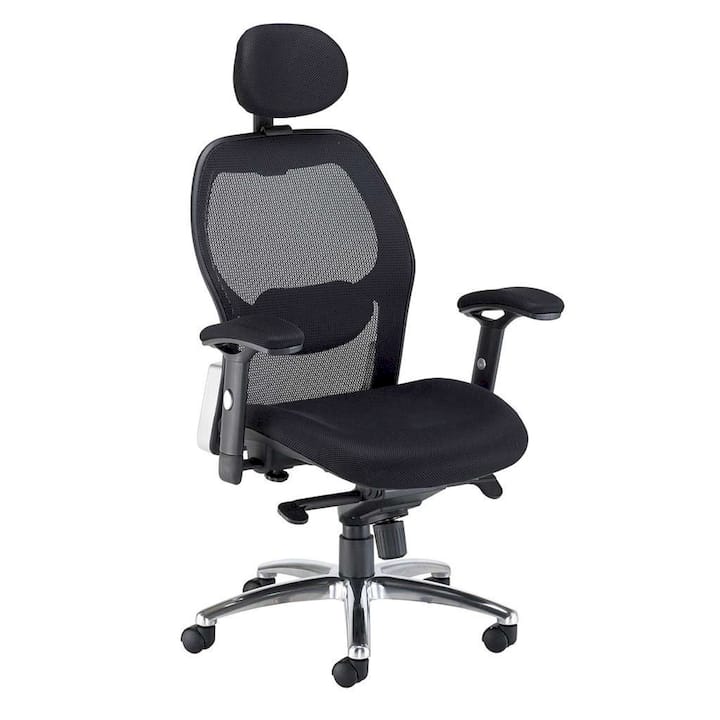
- Recline and dynamic back movement – avoid locking the backrest rigid, since dynamic sitting improves trunk muscle activation compared with static posture.
- Adjustable or removable armrests – fixed armrests that sit too high force an awkward reach and load the shoulders.
- Stable, smooth-rolling castors – for easy repositioning without straining to reach for items.
Pro Tip: During a multi-day trial, resist the urge to lock the recline mechanism “for stability”. A chair that moves slightly with you is doing its job.
Why publisher expertise matters when you’re buying for health outcomes
Health-related purchasing decisions carry more weight than picking a chair on colour alone, which is why the seller’s credentials matter here. Some suppliers provide furniture to the NHS, a status that requires meeting procurement and quality standards well beyond typical retail seating.
That backing translates into practical risk reduction for buyers. Nationwide delivery and installation mean a chair arrives fitted rather than flat-packed and guessed at, and warranty cover protects you if a mechanism fails under regular daily use. This article’s analysis is compiled by Syed, drawing on the systematic reviews and trial data cited throughout, with the aim of connecting that research to decisions you can actually act on.
How to choose and trial an ergonomic office chair
A short shop-floor sit-down tells you almost nothing useful. Run through this before you commit to a purchase:
- Confirm the chair has all six adjustable features listed above, not just seat height.
- Ask the supplier about trial length, return policy and warranty duration in writing.
- Check whether delivery includes fitting and adjustment guidance, not just drop-off.
- Ask if the model meets NHS or public-sector compliance standards, a useful proxy for build quality.
- Sit in it across at least two to four weeks of normal work before judging comfort, tracking any change in symptoms.
If pain persists despite a correctly fitted chair and consistent use, that is the point to escalate to an occupational health advisor or physiotherapist rather than trying a second or third chair.
Circulation, movement and preventing musculoskeletal disorders
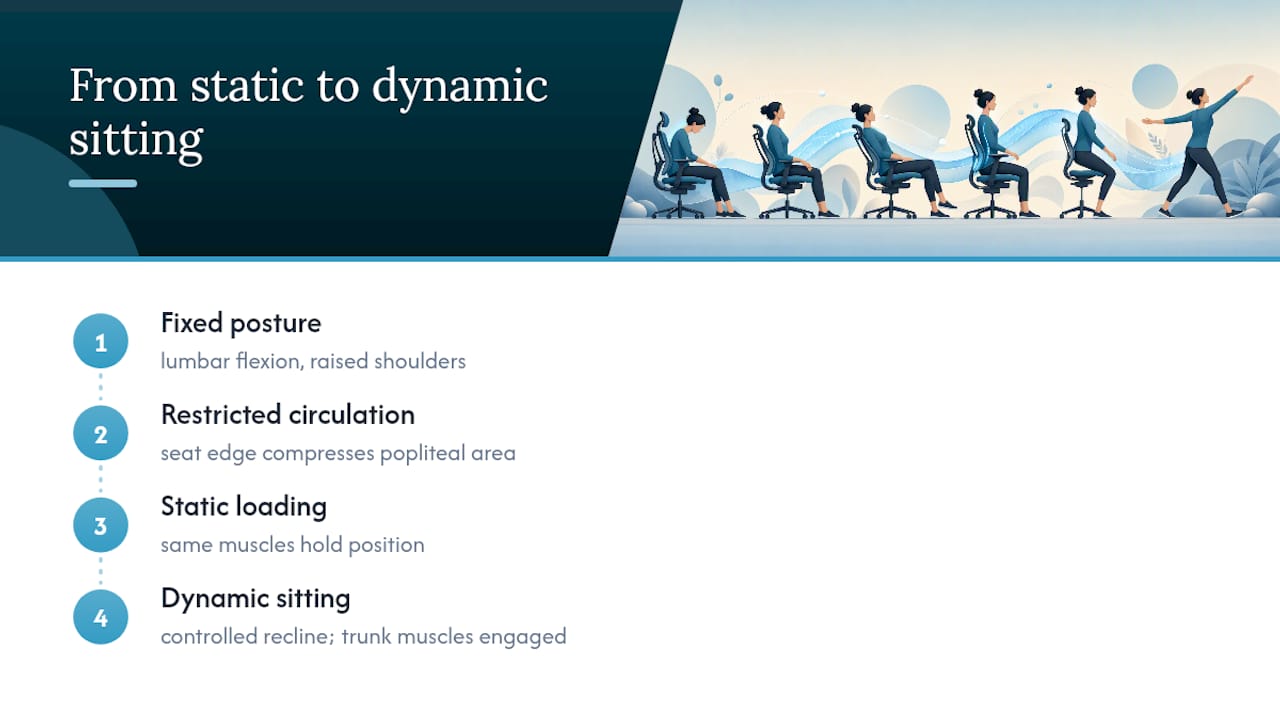
Sitting still for long stretches restricts blood flow to the legs, and a seat edge that digs into the back of your thighs makes that worse by compressing the popliteal area behind the knee. That is precisely why seat pan depth and the half-inch knee gap matter beyond comfort. They are a circulation safeguard as much as a posture one.
Musculoskeletal disorders rarely stem from a single bad sitting session. They build from repeated, cumulative strain: a lumbar spine forced into flexion for years, shoulders held in a raised position because armrests sit too high, or a neck craned forward towards a screen positioned too low. An adjustable chair interrupts that build-up by letting your body find a genuinely neutral position rather than compensating for a fixed, ill-fitting one.
Dynamic sitting adds a further layer of protection. Rather than locking the body into one static posture for eight hours, a chair that allows controlled recline and movement keeps trunk muscles engaged rather than switched off. Static loading, where the same muscles hold the same position without variation, is one of the recognised precursors to chronic musculoskeletal strain in desk-based roles.
None of this makes an ergonomic chair a guarantee against injury. It removes one significant contributing factor, alongside desk height, screen position and how often you get up and move. Treat the chair as the foundation that supports the rest of your workstation setup, not a substitute for taking breaks.
Ergonomic chairs versus standard office chairs
The difference between the two categories comes down to how much of the chair actually moves. A standard office chair typically offers seat height adjustment and perhaps a basic recline, with a backrest shape that is fixed regardless of who sits in it. An ergonomic chair is built around the idea that bodies differ, so seat depth, lumbar position, armrest height and recline tension all adjust independently.
That difference shows up directly in the research. The comfort and posture benefits detailed earlier in this article are consistently tied to chairs with multiple independent adjustment points, not to seating in general. A standard chair can still be comfortable for short periods, but it asks your body to adapt to its fixed shape. An ergonomic chair adapts to you instead.
| Factor | Standard office chair | Ergonomic chair |
|---|---|---|
| Best for (use case) | Short sitting periods, occasional use | Full working days, long desk sessions |
| Standout feature | Basic height adjustment only | Independent seat depth, lumbar and recline controls |
| Typical price/quality bracket | Lower upfront cost, limited adjustability | Higher upfront cost, backed by trial and warranty support |
Price is the obvious trade-off, and it is a fair one to weigh. A standard chair costs less at the till, but if it leaves you shifting constantly to find a bearable position, that discomfort has its own cost in concentration and, over months, in physical strain.
Is an ergonomic chair worth the cost?
The honest answer is that it depends on how many hours you spend in it. If a chair is used for six or more hours a day, five days a week, the maths shifts quickly in favour of paying more upfront. A poorly fitted chair used at that intensity accumulates strain daily, and the resulting discomfort, lost focus, or eventual physiotherapy costs can outweigh the price difference within a single year.
The comfort benefits alone justify the investment for most regular desk workers, given how consistently comfort improvements appear across dozens of clinical trials. Pain reduction is the less certain part of the equation, so it is worth setting realistic expectations rather than expecting a chair to resolve an existing condition on its own.
Warranty cover changes the calculation further. A chair with a multi-year warranty and a genuine trial period removes much of the financial risk from the decision, because you are not committing blind to a single model based on a five-minute showroom sit. Buying through a supplier that offers delivery and installation, rather than a flat-packed budget option, also reduces the chance of a chair being set up incorrectly from day one, which undermines the benefit before you have even started using it properly.
Considered against a full working year, the cost of a properly fitted ergonomic chair tends to work out as a modest daily figure, set against hours of direct physical contact with your body every single day. Few other purchases in an office get used quite that intensively.
Practical perspective: realistic expectations and next steps
A chair changes your posture and comfort; it will not undo years of poor habits by itself. Treat the first month as a trial, not a verdict: adjust the settings daily, notice what changes, and reassess after two to four weeks. If discomfort persists despite a correct fit, that is a signal to bring in occupational health or physiotherapy support, not to keep swapping chairs.
— Syed
Finding the right Alxr chair for how you actually work
A trial period, fitted delivery and warranty cover that turn “does this chair suit me” from a guess into a tested answer can be offered by some suppliers, backed by NHS-approved supply standards most retail sellers cannot match.
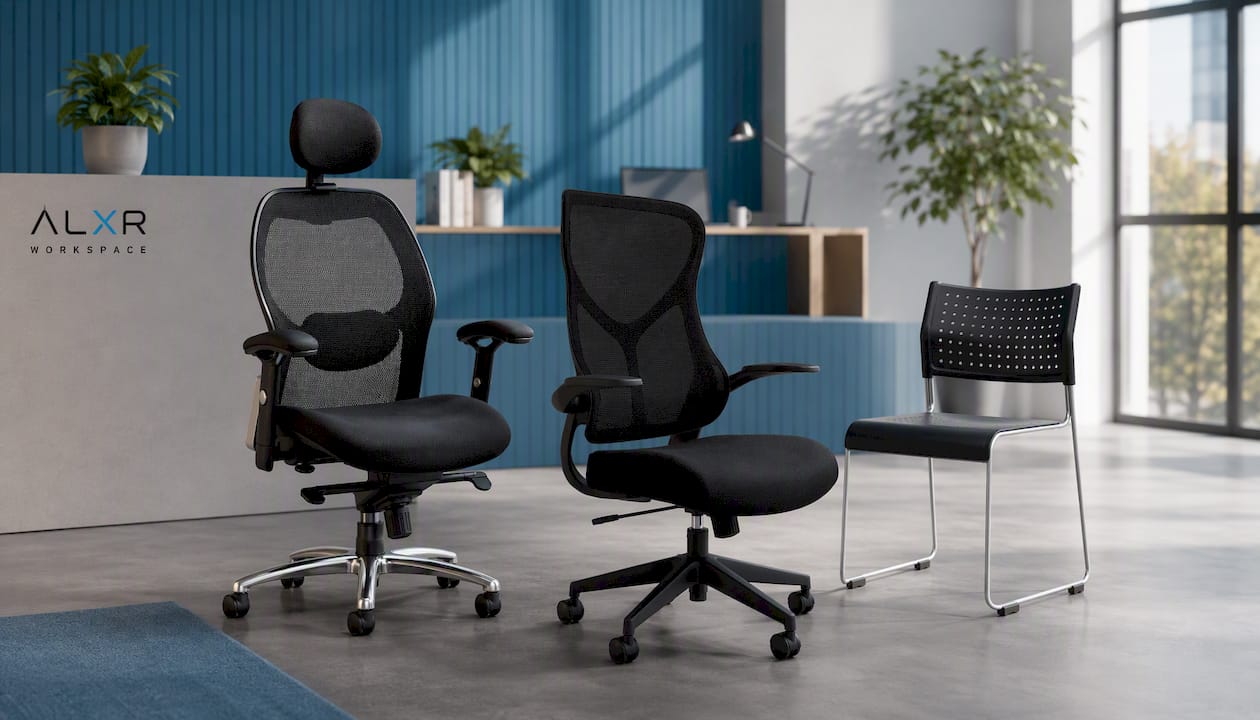
If you spend most of the day at a fixed desk and want strong lumbar support with good airflow, the Vision Mesh Office Chair is built for exactly that. Shared or multi-user desks tend to suit the Zip Mesh Back Chair with Folding Arms, since folding arms let it tuck under a desk when the space is used by different people through the day. Meeting rooms and training spaces are better served by the Twilight Stacker Chair, which keeps the comfort principles above without needing permanent floor space. If your set-up also involves standing intervals, pairing seating with a sit-stand desk extends the same posture logic further. For a wider look at how seating choice affects daily comfort, A supplier’s own guide on why the right chair matters for daily work can be worth a read., and for those thinking about focus and task efficiency alongside comfort, this piece on AI-assisted productivity workflows is a useful companion. Get in touch through Alxr’s workspace enquiry page to arrange a trial, delivery, and installation for your team.
Sources
- The effectiveness of a chair intervention in the workplace to reduce musculoskeletal symptoms. A systematic review - PMC
- Effects of ergonomic chairs on workplace musculoskeletal health: systematic review
- Practical guidance on testing chairs and dynamic sitting - PMC
FAQ
What is the 90-90-90 rule for sitting?
It describes the target angles for hips, knees and elbows, each at roughly 90 degrees, with feet flat on the floor and forearms level on the desk, as a starting point for seat and desk height adjustment.
What are the downsides of using ergonomic chairs?
They cost more upfront than standard seating, and the pain-relief evidence is mixed rather than guaranteed, so a chair alone will not resolve an existing musculoskeletal condition without other changes.
What are the main benefits of ergonomics?
Better posture and spinal alignment, improved comfort and pressure distribution, potential reduction in some pain symptoms, steadier concentration, and lower strain on circulation from prolonged static sitting.
Do ergonomic chairs really help?
Yes, particularly for comfort and posture, where the evidence is consistent; pain relief varies more by individual and by how well the chair is fitted and adjusted, according to reviews of randomised controlled trials.