

Move Your Feet Every 20–30 Minutes: Footrest Ergonomics for UK Offices
A footrest helps when your feet cannot rest flat on the floor after your chair is correctly adjusted, or when a raised desk forces your knees below hip height. Used properly, it supports your feet, keeps your pelvis in a neutral position, and encourages you to use the backrest more often. The real payoff comes from moving your feet on it regularly, not from finding one perfect fixed position and holding it all day.
TL;DR:
- A footrest is only necessary if your chair adjustment leaves your feet dangling or your knees are above hip level, especially for shorter individuals or standing desk users.
- Using a properly sized and adjustable footrest at a slight angle can improve sitting posture and reduce muscle fatigue during prolonged standing or sitting.
- Regular movement of the feet on the footrest every 20 to 30 minutes benefits circulation and prevents discomfort, rather than fixing the feet in one static position.
- An unstable, improperly set footrest can cause pressure points, pelvis twisting, or discomfort, highlighting the importance of correct setup and shifting routines.
- Footrest maintenance involves weekly cleaning, monthly inspection, and avoiding crossing legs or locking into rigid positions that impair posture.
Table of Contents
- Who needs a footrest and when should you add one?
- What does the evidence say about posture and circulation?
- Which type of footrest suits your desk and body?
- How do you set the height, angle and position correctly?
- Can you use a footrest with a sit–stand desk?
- What mistakes should you watch for?
- How do you maintain and clean a footrest properly?
- ALXR perspective: why foot support belongs in the whole workstation
- Ready to build a workstation that supports correct foot positioning?
- Sources
Who needs a footrest and when should you add one?
Start with your chair, not the footrest. If you raise the seat so your thighs sit level with your hips and your feet then dangle above the floor, or you feel pressure behind your knees against the seat edge, that is your signal. Ergonomics guidance broadly agrees that a footrest is for cases where floor support is missing, not a universal add-on for every desk.
Watch for these signs after you have adjusted your chair correctly:
- Feet swinging free or only touching the floor with your toes
- Cold feet, tingling, or visible swelling by mid-afternoon
- Lower back discomfort that builds through the day
- A gap of more than a couple of centimetres between your feet and the floor
Shorter people, anyone using a chair raised to match a fixed-height desk, and people switching between sitting and standing all tend to need one. If you are between permanent solutions, even a sturdy box works as a stopgap while you sort out proper equipment.
What does the evidence say about posture and circulation?
The research on footrests is more nuanced than most product pages suggest, and it is worth knowing what it actually shows before you buy anything. A laboratory study on computer tasks found that using an angled footrest increased backrest contact by roughly 10% and helped participants rotate their pelvis towards the backrest, producing a more neutral sitting posture. Muscle activity readings from the same study were mixed, which tells you the benefit is largely behavioural. People sit differently and lean back more, rather than every muscle group working measurably less hard.
In numbers: one experimental study testing footrest height at 0%, 5%, 10% and 15% of body height during prolonged standing work found the 10% and 15% settings reduced both muscle fatigue and pain intensity compared with no footrest at all.
That standing-desk finding does not transpose directly onto seated computer work, but it does support using a normalised height rather than guessing. Two authoritative bodies back the basic principle for seated posture:
- The HSE recommends full foot support from the floor or a footrest as part of correct display screen equipment setup.
- Mayo Clinic advises arranging your workstation so you can sit with feet flat on the floor or on a footrest to maintain a neutral spine.
None of this supports fixing your feet in one spot for eight hours. The consistent theme across the literature is that posture variability beats a single static position, however correct that position looks on paper.
Which type of footrest suits your desk and body?
Footrests are not interchangeable, and the wrong one can create new problems rather than solving old ones. Here is what you are choosing between:
- Fixed platform – a static, non-adjustable slope; cheap and stable but only right if your body size happens to match it.
- Height-adjustable – lets you fine-tune elevation to your leg length and chair height, useful if several people share the desk.
- Angle-adjustable – tilts a few degrees to encourage ankle movement rather than a flat, static plant.
- Rocking or active footrests – designed to shift under gentle pressure, prompting small leg movements through the day.
- Contoured footstools – curved or ridged surfaces that vary contact points and can feel less monotonous than a flat plate.
- Temporary options – a stack of books or a sturdy box, fine short term but rarely stable or the right height long term.
When comparing models, prioritise a non-slip base, a platform wide enough for both feet without cramping, an angle range rather than a single fixed tilt, and a material that will not compress or crack under daily use.
Pro Tip: Measure the clearance under your desk before you order anything. A footrest that is perfect on paper is useless if your desk’s crossbar or drawer unit leaves no room for your knees to sit comfortably above it.
How do you set the height, angle and position correctly?
Get your chair right first, then bring the footrest to your feet rather than the other way round.
- Adjust your chair so your knees sit at roughly 90 to 110 degrees and there is a 2 to 3 centimetre gap behind your knees against the seat edge.
- Slide the footrest centrally under the desk until your feet rest flat with no reaching or stretching forward.
- If it is angle-adjustable, start at a shallow 5 to 15 degree tilt rather than flat, since a slight slope keeps your ankles active.
- Check the base does not slide on hard flooring. Add a thin anti-slip mat underneath rather than raising the footrest to compensate for wobble.
- Confirm your thighs still make contact with the seat. If the footrest lifts your legs so high that thigh contact disappears, lower it.
Once it is set up, treat it as something to move on, not a shelf for your feet. A practical routine is to swap positions roughly every 20 to 30 minutes: both feet flat, then a staggered stance with one foot slightly forward, then a brief single-foot lift, then a few ankle flexes before returning to flat. Pairing this with short micro-breaks does more for circulation than any single “correct” position ever will.
Pro Tip: Set a silent timer for 25 minutes. When it goes off, change your foot position before you even look at the screen. It takes seconds and it is the single easiest habit to build into an otherwise sedentary day.
Can you use a footrest with a sit–stand desk?
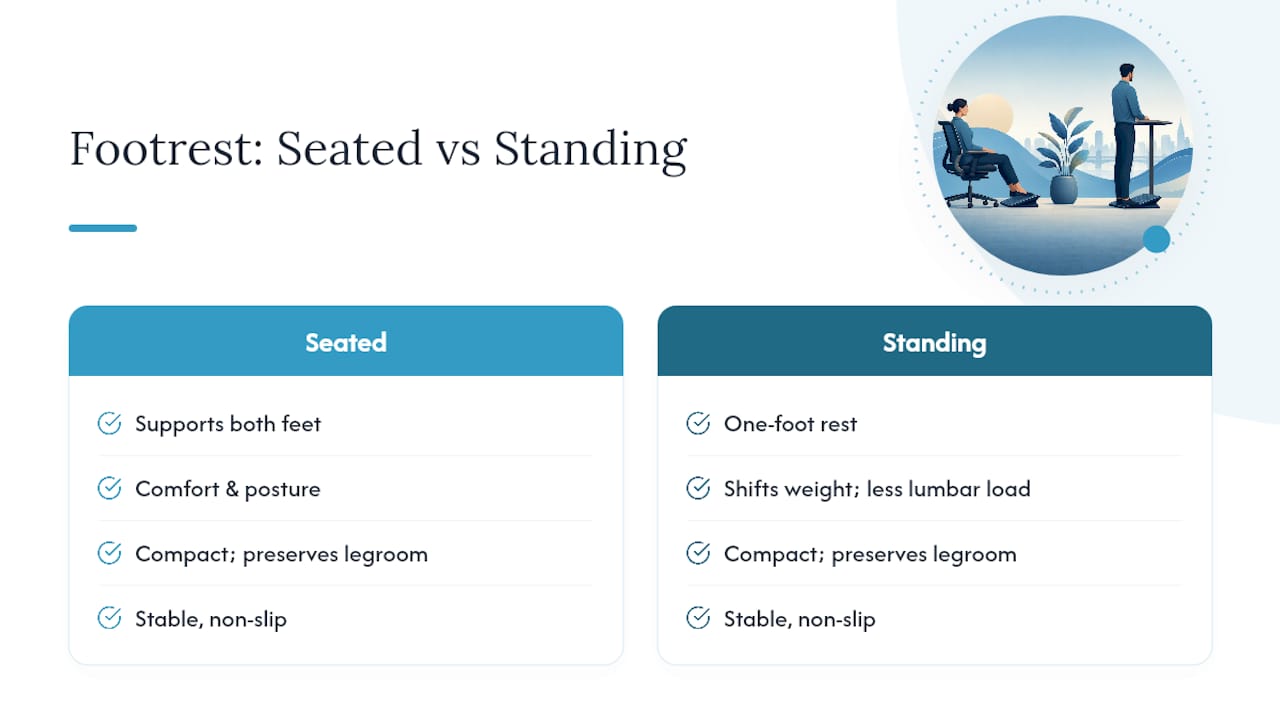
Yes, and it earns its place in both modes. During seated intervals, it supports your feet exactly as it would at a fixed desk. When you raise the desk, a low platform lets you rest one foot at a time while standing, which shifts your weight and reduces lumbar loading compared with standing flat-footed for long stretches. Choose a compact, stable platform that will not intrude on legroom in either position, and check it will not slide when the desk height changes.
What mistakes should you watch for?
Most footrest problems come from small setup errors rather than the product itself:
- Setting it too high, which lifts your thighs off the seat and creates new pressure points
- Locking into one position for hours instead of shifting through the routine above
- Using an unstable box or stool that rocks or slides underfoot
- Crossing your legs on the footrest, which twists your pelvis out of neutral
If you notice persistent numbness, worsening pain, or symptoms that do not ease after adjusting height, angle and position, that is a red flag worth raising with an occupational health professional or ergonomist rather than fiddling further on your own.
How do you maintain and clean a footrest properly?
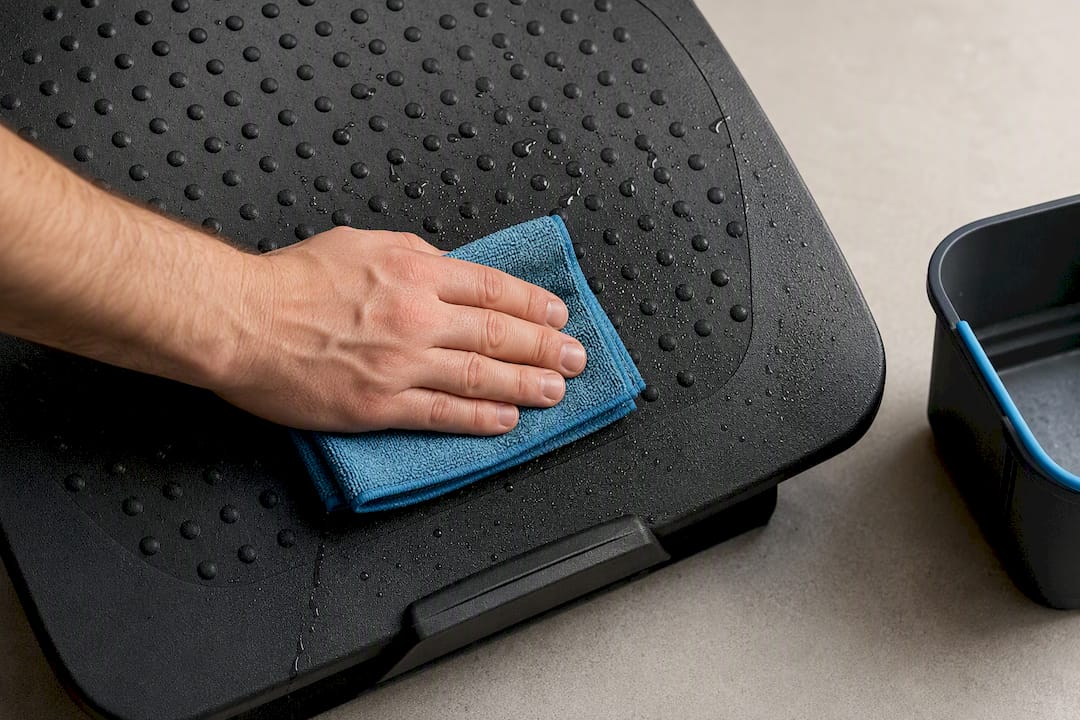
A footrest sees more foot contact than almost any other piece of office kit, so hygiene matters more than people assume. Wipe hard plastic or textured rubber surfaces weekly with a damp cloth and mild detergent, and dry thoroughly, since trapped moisture on textured grips can encourage bacterial growth over time. Fabric-covered or padded models need a vacuum pass to lift dust and grit out of the texture, plus an occasional check for any manufacturer-approved fabric cleaner if spills happen.
Inspect the base and any moving mechanism monthly. Rocking or angle-adjustable footrests have pivot points that pick up dust and hair, which can eventually stiffen the movement or throw off the tilt you set deliberately. A quick brush-out and, where the manufacturer allows it, a drop of silicone lubricant on the pivot keeps the mechanism smooth.
Check for wear signs that affect safety rather than just appearance: a base that has started to crack, a non-slip pad that has gone smooth and shiny, or a platform edge that has begun to splinter or delaminate. Any of these is a sign to replace rather than repair, since a footrest that fails underfoot is a trip hazard, not just an inconvenience. In shared or healthcare settings, more frequent cleaning between users is sensible practice given the direct, repeated contact involved.
ALXR perspective: why foot support belongs in the whole workstation
Foot support rarely fixes anything in isolation. It works alongside the right chair height and a desk that lets both sit comfortably, which is why we favour adjustable footrests over fixed ones when we specify workstations for clients. We see the same pattern repeatedly: postural complaints resolve faster when the chair, desk and footrest are set as one system rather than three separate purchases.
— Syed
Ready to build a workstation that supports correct foot positioning?
If you have been comparing standalone footrests against fixing the root problem, the desk and chair, office furniture suppliers sell pieces that make correct foot positioning possible in the first place, with delivery and installation services available.
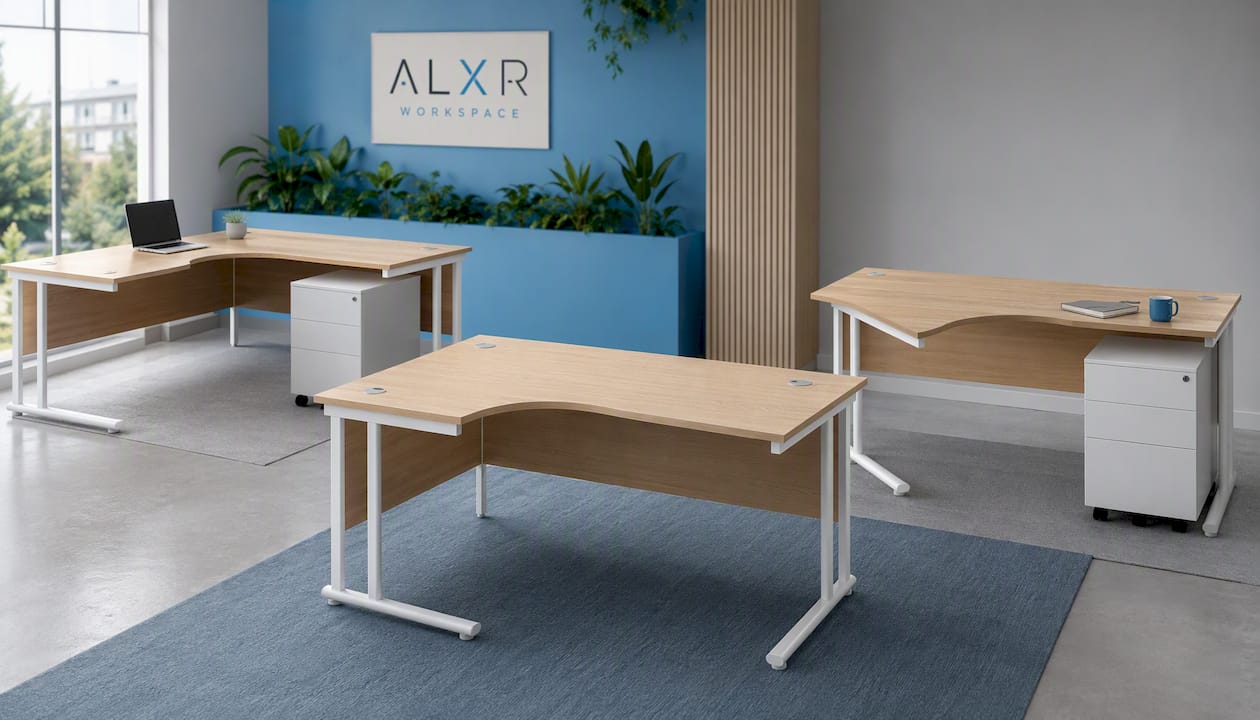
Our Twin Upright Left Hand Radial Desk + Under Desk Steel Pedestal 3 Drawers (FSC) and its right-hand equivalent give you drawer storage without sacrificing knee clearance, while the Twin Upright Left Hand Radial Desk (FSC) suits anyone who wants the same footprint without the pedestal underneath. Pair any of these with an ergonomic posture chair and you have the chair-desk foundation a footrest is meant to complete, not compensate for. Contact office furniture specialists for workspace planning support or a guidance call to help specify a setup that fits your team’s actual body sizes rather than a generic average.
Sources
- The effects of using a footrest during computer tasks varying in complexity and temporal demands: A postural and electromyographic analysis
- Effects of footrest heights on muscle fatigue, kinematics, and kinetics during prolonged standing work
- HSE: Display screen equipment and workstation setup
- Mayo Clinic: Office ergonomics
- Footrest ergonomics: how to choose and use one properly (worksmarthub)