

Five minute high stool ergonomics setup for workspace comfort
Set the stool so your hips sit slightly above your knees and your feet rest on a stable foot ring. That single adjustment fixes most high-stool discomfort, whether you’re at a bar-height breakfast bar or a laboratory bench. Get the height and foot support right first; everything else, from seat tilt to backrest, is fine-tuning around that base.
TL;DR:
- A foot ring that is adjustable, wide, and positioned correctly is crucial for foot support and circulation during long shifts on high stools.
- Choosing a stool with a height range that covers your specific counter or bar height, ideally from 54cm to over 74cm, ensures comfort for most users.
- The optimal seat height is roughly 25 to 30cm below the work surface, with fine-tuning needed to match individual leg length and task duration.
- High stools are most effective for tasks involving frequent standing and sitting transitions, not continuous static work like extended computer sessions.
- Prioritize a continuous height adjustment, a sturdy base, and a reliable lift mechanism over upholstery or aesthetics when selecting ergonomic high seating.
Table of Contents
- What are the main types of high stools and when should you use each?
- Which ergonomic features actually change how a high stool feels?
- How do you measure and set a high stool for your surface?
- What does the research say about posture and the limits of high-stool sitting?
- How do you choose the right high stool for your space?
- Which materials keep a high stool comfortable over time?
- How can Alxr help with high stool seating for your workspace?
- Why high-stool ergonomics gets oversimplified
- Ready to fit out a workspace with proper high-seating support?
- Sources
- FAQ
What are the main types of high stools and when should you use each?
High stools aren’t interchangeable. Picking the wrong category is usually why people blame “the stool” when the real problem is the mismatch between the design and the task.
- Saddle/active stools: a curved, split seat that tips your pelvis forward and opens the hip angle. Best for tasks with frequent sit-to-stand transitions, like a reception desk or a workshop bench.
- Sit-stand operator stools: gas-lift, wide adjustment range, often with a small backrest. Suited to lab work, till points, and short bursts at a raised counter.
- Stools with full backrests: closer to a normal chair on legs. Better for longer seated stretches where lower back support matters more than mobility.
- Cushioned bar stools: comfortable for socialising or short meals, poor for anything beyond 20 to 30 minutes of static sitting.
The trade-off is consistent: the more freedom a stool gives your hips and knees to move, the less passive back support it offers. Choose based on how long you’ll actually stay seated, not how the stool looks in a showroom.
Which ergonomic features actually change how a high stool feels?
Most stools look similar from a distance. The features that separate a comfortable one from a painful one are smaller than you’d expect.
Height range matters more than any other spec. A stool needs continuous adjustment covering both counter height (roughly 90cm surfaces) and full bar height (around 110cm), not two fixed positions. Some clinical saddle stools extend from 54cm to 74cm in their high-model range, which covers most adults and taller users on elevated benches.
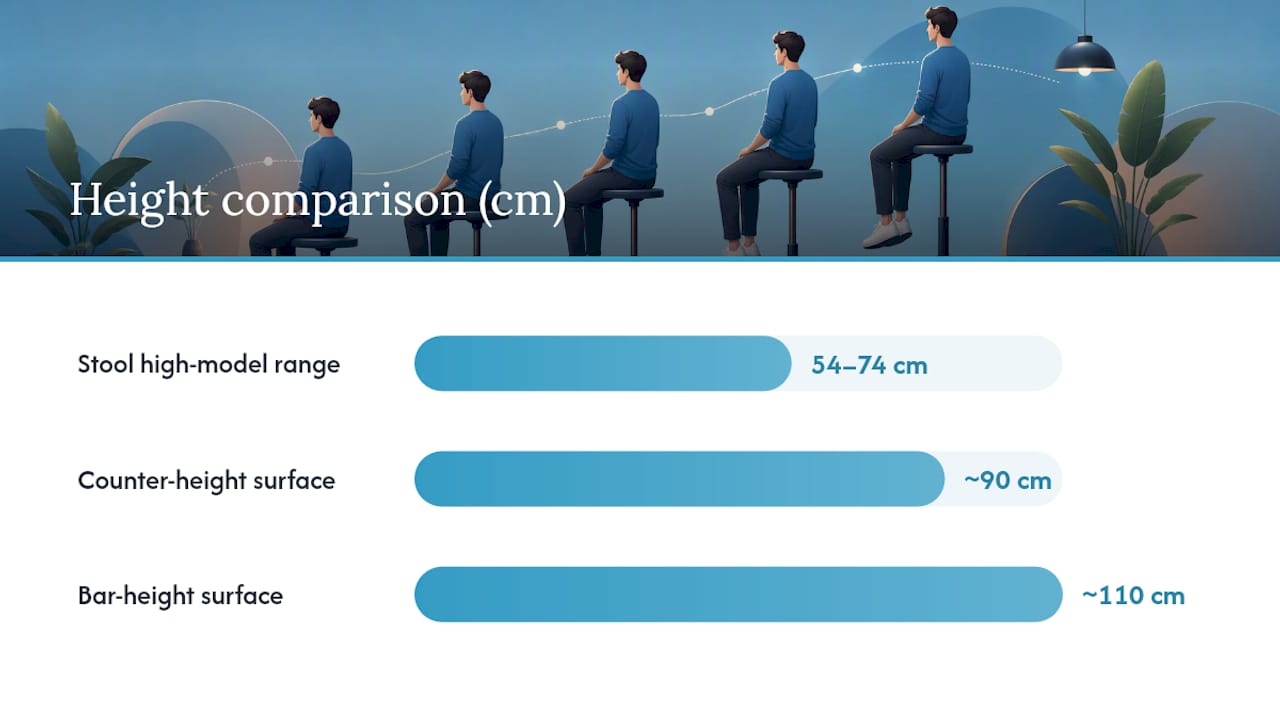
Foot ring placement is where most stools fail. A ring set too low or too narrow pushes your weight onto your toes and restricts circulation. Adjustable rings with a wide diameter let you rest the whole foot flat, not just the ball of it.
Seat tilt and shape decide your pelvic position. A forward-tilted saddle seat reduces lower-limb range of motion during stand-to-sit movements without necessarily increasing lumbar curve, according to research on ergonomic seat kinematics. That’s a useful correction to the common claim that saddle seats automatically “fix your posture.” They open the hips; your spine still needs to do its own work.
- Backrests help longer static tasks but restrict the micro-movements that make active sitting effective.
- Armrests reduce hip load on rising but can get in the way of desk-height tasks.
- Upholstery affects grip and pressure distribution more than most buyers expect.
Pro Tip: If you’re torn between two models, request the exact foot ring diameter in millimetres, not just “adjustable.” A ring under 25mm thick digs into the underside of the foot on long shifts.
How do you measure and set a high stool for your surface?
Getting the numbers right takes five minutes and mostly ends the guesswork.
- Measure your work surface height from the floor. Standard kitchen counters run about 90cm; bar-height counters and raised benches sit around 105 to 115cm.
- Calculate target seat height: subtract roughly 25 to 30cm from the surface height. For a 90cm counter, aim for a 60 to 65cm seat. For a 110cm bar, aim for 80 to 85cm.
- Set a slight forward tilt if the stool allows it, then sit and check that your hip angle feels slightly open rather than folded. If your lower back rounds within a minute, reduce the tilt.
- Adjust the foot ring so your knees sit close to a right angle and your whole foot rests flat, not tiptoe.
- Test standing up three or four times. If you push hard through your hands or feel a knee twinge, the seat is too low.
Pro Tip: When two people share a stool, prioritise a wide adjustment range over a “perfect” fixed height. A 20cm range covers most household height differences without a second stool.
What does the research say about posture and the limits of high-stool sitting?
High stools aren’t a gimmick. Rising from a high seat cuts peak knee moment by over 60% compared with an ordinary chair height, and adding armrest support roughly halves the load through the hip during the same movement. That’s a genuine biomechanical case for using elevated seating whenever a task involves frequent standing up and sitting down.
The catch is that this advantage only holds for active, transitional sitting. Where high stools go wrong:
- Using them for long, static keyboard sessions with no backrest support, which fatigues the lower back within an hour or two.
- Sitting still for extended periods without alternating posture, which cancels the “active sitting” benefit the design relies on.
- Choosing a fixed-height stool for tasks that genuinely need a full ergonomic chair, like extended computer work.
For sustained desk work, alternating between a stool and a proper ergonomic posture chair tends to serve people better than committing to one seating type all day. Prolonged static sitting carries its own risks regardless of seat height, so the stool works best as one posture among several, not a permanent fix.
How do you choose the right high stool for your space?
Match the checklist to the task before comparing prices; a lab bench, a reception counter, and a home kitchen island all need different priorities.
- Height range: does it cover your specific surface, with room either side for other users?
- Foot ring: adjustable position, wide diameter, secure fit with no wobble.
- Tilt control: available and easy to reach without dismounting the stool.
- Seat shape: saddle for active tasks, flat and padded for longer static periods.
- Weight rating and base stability: check the manufacturer figure, not an estimate.
- Warranty and installation: especially relevant for commercial and healthcare buyers ordering multiples.
When comparing suppliers, ask for the exact seat height range in centimetres, the foot ring diameter, and whether tilt is continuous or fixed at set notches. A physiotherapy blog on daily posture correction is worth a read if you want more on pairing seating choices with movement habits through the working day. Higher prices are usually justified by wider height ranges, better foot ring engineering, and gas lifts rated for heavier daily use, not by upholstery alone.
Which materials keep a high stool comfortable over time?
Cushioning choice affects both comfort and how the stool ages. Memory foam distributes pressure well but retains heat, which matters on stools used for hours at a stretch, according to guidance on memory foam’s pressure-relieving properties. Vinyl and leather wipe clean fast but can feel warm and sticky in summer; mesh breathes better but offers less cushioning on hard bench edges.
- Check the gas lift for smooth, silent movement every few months.
- Inspect the foot ring for looseness or corrosion, particularly outdoors or near sinks.
- Wipe upholstery weekly in commercial settings; deep-clean fabric seats quarterly.
- Replace a stool once the lift no longer holds height under load or the foot ring has visible play.
A stool that creaks, drifts down under weight, or wobbles at the base has stopped being ergonomic. No seat height calculation matters once the mechanism can’t hold it.
How can Alxr help with high stool seating for your workspace?
Buying one stool is straightforward. Specifying dozens across a clinic, school, or office is a different job, and that’s where a proper supplier relationship pays off.
- Nationwide delivery and installation, so multiple stools and desks arrive fitted and ready rather than in flat-pack boxes.
- Space planning and design support to match stool height, foot ring position, and desk height across a whole floor or department.
- Warranty backing on furniture bought as part of a wider workspace order.
Alxr’s status as an NHS-approved supplier reflects the kind of scrutiny healthcare procurement applies to seating specifications, which is useful reassurance if you’re buying for a clinical or public sector setting. Pairing high stools with a height-adjustable desk, such as a radial desk configuration, keeps counter height and seat height working together rather than fighting each other.
Why high-stool ergonomics gets oversimplified
The biggest myth in this space is that a saddle seat alone fixes posture. It doesn’t. The research is clear that seat tilt changes pelvic and hip mechanics, but lumbar curve depends on the person, not the seat shape. Set the height and foot ring correctly first; treat every other feature as refinement.
— Syed
Ready to fit out a workspace with proper high-seating support?
If you’re specifying stools for a reception desk, lab bench, or staffroom, matching height ranges across multiple units by eye rarely ends well. Some furniture catalogues pair ergonomic seating with desks designed for the same working height, with delivery and installation services to provide a fitted set-up rather than flat-pack boxes.
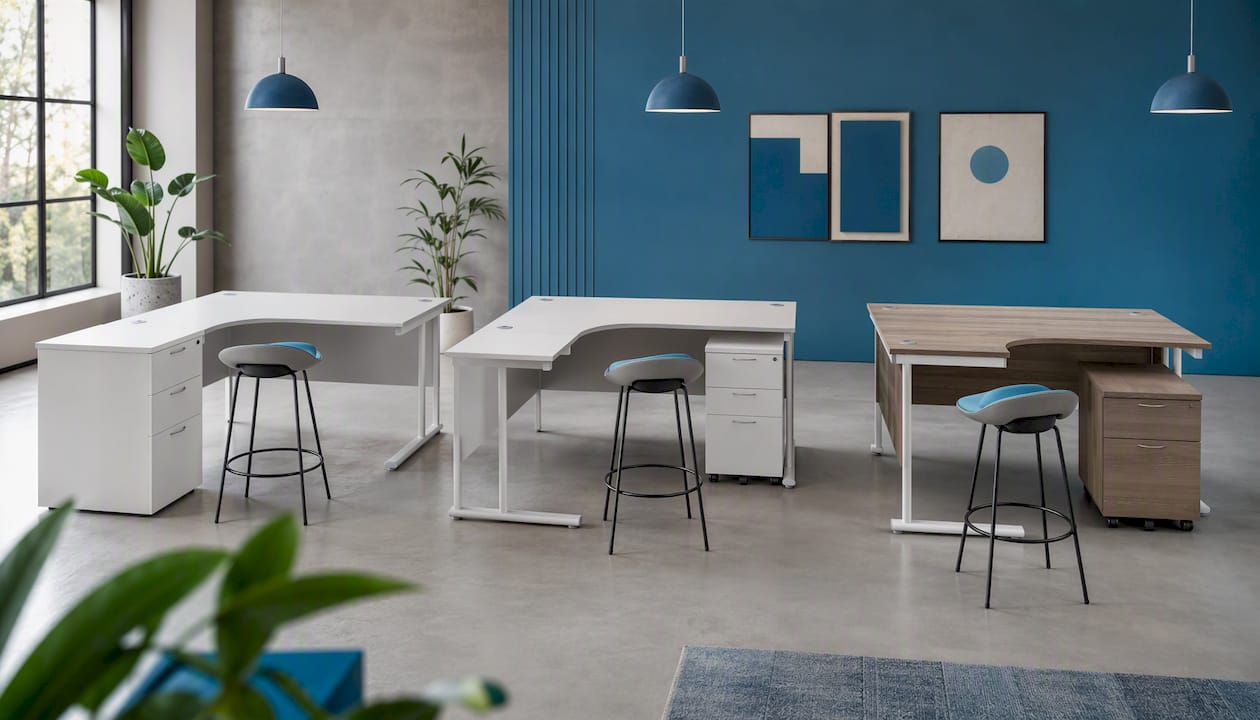
For workspaces that combine high stools with sit-stand desking, options like the twin upright radial desk with a high mobile pedestal or the compact mobile pedestal configuration give you flexibility on desk height to match whichever stool range you settle on. With appropriate space planning support, suppliers can help you specify the right height ranges before you order rather than after. Head to the Alxr workspace catalogue to browse seating and desking together, or request a quote for a multi-unit installation.
Sources
- The effects of armrests and high seat heights on lower-limb joint load and muscular activity during sitting and rising
- Impact of an ergonomic seat on the stand-to-sit strategy in healthy subjects: Spinal and lower limbs kinematics
- Standard Ergonomic Saddle Stool
FAQ
How can I make sitting on a stool more comfortable?
Set the seat height so your hips sit slightly above your knees, then adjust the foot ring so your whole foot rests flat rather than on tiptoe. A slight forward tilt on saddle-style seats also helps keep your hip angle open without straining your lower back.
Is it better to sit higher or lower in a chair?
Sitting slightly higher, with hips a touch above knee level, tends to reduce strain when standing up. Research on rising from high seats shows this position cuts peak knee moment substantially compared with lower, standard chair heights.
What is the best ergonomic stool for sitting?
The right stool depends on the task: saddle-style stools suit frequent standing and sitting, while stools with a backrest suit longer static periods. Some catalogues include ergonomic seating options that can be specified alongside height-adjustable desks for a matched setup.
What is a good height for a sitting stool?
Aim for roughly 25 to 30cm below your work surface height, so a 90cm counter needs a seat around 60 to 65cm and a 110cm bar needs around 80 to 85cm. Fine-tune from there until your knees sit close to a right angle with feet flat on the foot ring.