

Order 4–6 weeks early: office furniture lead times for procurement
Stock office furniture typically ships within a few working days, while custom pieces can take several weeks domestically and longer for European imports once customs clears. The one rule that keeps a fit-out on track: identify your longest-lead item, add a 4 to 6-week buffer, then work backwards from your installation date. Check live lead times when you place the order, and flag anything custom before specification closes.
TL;DR:
- Most custom and imported office furniture items require at least 12 to 24 weeks from order to arrival, including production, customs, and transit times.
- Always identify the longest-lead item in your scheme and add a 4 to 6-week buffer to determine your minimum order-to-installation window.
- Factory capacity, material sourcing, shipping method, and customs paperwork are primary causes of delays, while internal approval cycles can add extra weeks.
- Building a schedule backwards from your installation date and pre-approving alternatives can help mitigate schedule risks and ensure timely delivery.
- Working with suppliers that provide real-time lead time updates and nationwide delivery support can greatly improve project predictability.
Table of Contents
- Typical office furniture lead times by category
- What actually drives office furniture lead times?
- How to build an ordering calendar that actually holds
- Quick-ship and contingency tactics for tight deadlines
- How Alxr supports on-time delivery and installation
- A practitioner’s checklist for procurement teams
- Alxr: lead-time certainty for your next fit-out
- Sources
- FAQ
Typical office furniture lead times by category
Lead time is not just the manufacturing clock. It runs from the moment you place the order to the moment goods land on site, covering processing, production, quality checks, packing, transit, customs, and last-mile delivery. That distinction explains why a “6 week” quote from a factory can quietly become 9 or 10 weeks once you account for the whole journey, as the Procurist lead-time guide sets out.
Ranges vary sharply by category:
- Stock and ready-made furniture: many UK suppliers publish delivery windows of one to ten working days for in-stock items, with standard ground-floor delivery Monday to Friday as the default.
- Custom upholstery: 8 to 16 weeks domestically. Add extra weeks if you’re supplying customer’s own material (COM), since fabric sourcing runs on its own separate timeline.
- Custom millwork and cabinetry: 10 to 20 weeks is typical, longer again for artisan or hand-finished joinery.
- Case goods, lighting, and rugs: generally align with stock or custom ranges above depending on whether the item is a catalogue product or a bespoke commission.
- European imports: production plus shipping plus customs commonly totals 12 to 24-plus weeks once everything is added together.
The category split matters because most fit-outs blend all of these. A desking scheme might be quick-ship, while the reception joinery and a handful of bespoke upholstered pieces drag the whole project out. Plan around the slowest item, not the average.
What actually drives office furniture lead times?
Four factors decide whether a quoted lead time holds up or slips.
- Factory scheduling and capacity. Order books at furniture factories and workshops don’t clear quickly, so lead times tend to be a structural feature of the industry rather than a temporary blip.
- Materials and COM sourcing. Fabric, veneer, and specialist finishes often have their own supply chains, and a delay in fabric arrival stalls the whole upholstery run.
- Shipping method. Sea freight from Europe is cheaper but slower; air freight or expedited road transport costs more but can shave weeks off transit.
- Customs and documentation. Post-Brexit paperwork can add 1 to 2 weeks to European import lead times into the UK.
A fifth, less discussed driver sits inside your own organisation: client approval cycles. Sign-off on fabric swatches, finish samples, or layout revisions routinely adds weeks that never show up in a supplier’s quoted lead time.
Rule of thumb: take your longest-lead item and add a 4 to 6-week buffer before you set your installation date. That buffer absorbs factory slippage, customs delays, and the internal approval cycle in one move.
How to build an ordering calendar that actually holds
Backwards planning turns lead-time ranges into a working schedule. Here’s the sequence:
- Specify early, and flag long-lead items immediately. As soon as furniture is chosen, identify anything custom, COM, or imported. These items set the pace for everything else.
- Apply the buffer rule. Take the longest lead time in the scheme, add 4 to 6 weeks, and treat that total as your minimum order-to-install window.
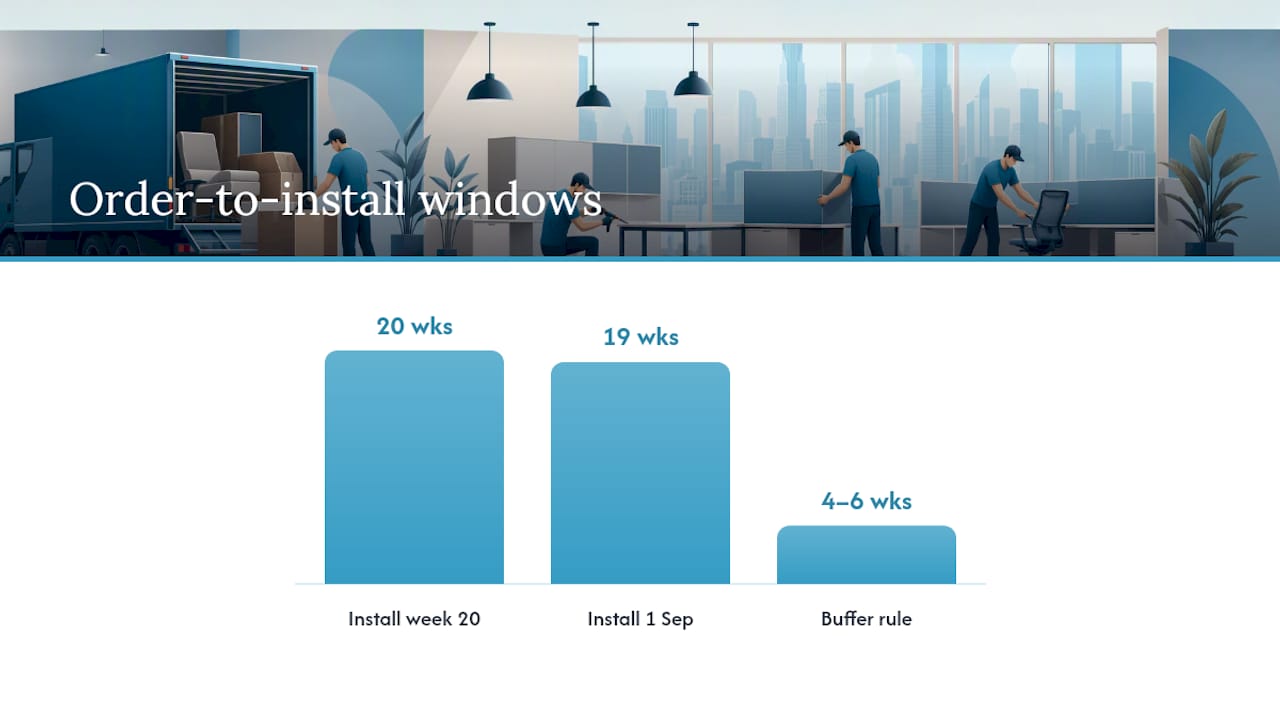
- Work backwards from your installation date. If installation is set for week 20 and your longest-lead item needs 16 weeks plus a 4-week buffer, your order needs to go in at week 0, not week 4.
- Pre-approve alternates and assign a decision owner. Every long-lead item should have a fallback option agreed in advance, with one named person able to sign off a substitution without a committee meeting.
- Book delivery and installation slots early. Installers and delivery teams get booked out too, particularly around quarter-end and financial year-end fit-out pushes.
Pro Tip: Build your calendar around the single slowest item in the scheme, not the average across all items. A desking order that ships in two weeks does you no good if the bespoke joinery isn’t ready for another four months.
A worked example: installation is booked for 1 September. The longest-lead item is custom upholstered soft seating at 14 weeks. Add a 5-week buffer, and the order needs to be placed by roughly 1 April, five months before anyone sits in the finished space.
Quick-ship and contingency tactics for tight deadlines
When the calendar is already tight, a few tactics buy back time without derailing the whole project.
- Quick-ship programmes can deliver select SKUs in as little as two working weeks, but the trade-off is a restricted range of finishes and configurations.
- Expedited manufacture or air freight can shave real time off custom orders, usually at a meaningful cost premium, and it’s worth reserving for the one or two items that would otherwise blow the whole schedule.
- Pre-approved alternates with staged delivery keep installers working even when one line item is delayed, rather than halting the whole fit-out for a single missing piece.
- Contractual substitution clauses agreed at order stage reduce friction later, since the supplier already has your approved fallback on file rather than waiting on a fresh sign-off mid-project.
How Alxr supports on-time delivery and installation
A large part of avoiding lead-time surprises is working with a supplier that gives you visibility rather than a single quoted date and silence. Alxr’s workspace catalogue runs nationwide delivery and installation as a standard service, backed by warranty support, which matters most when a scheme includes several long-lead items that need coordinating on site together.
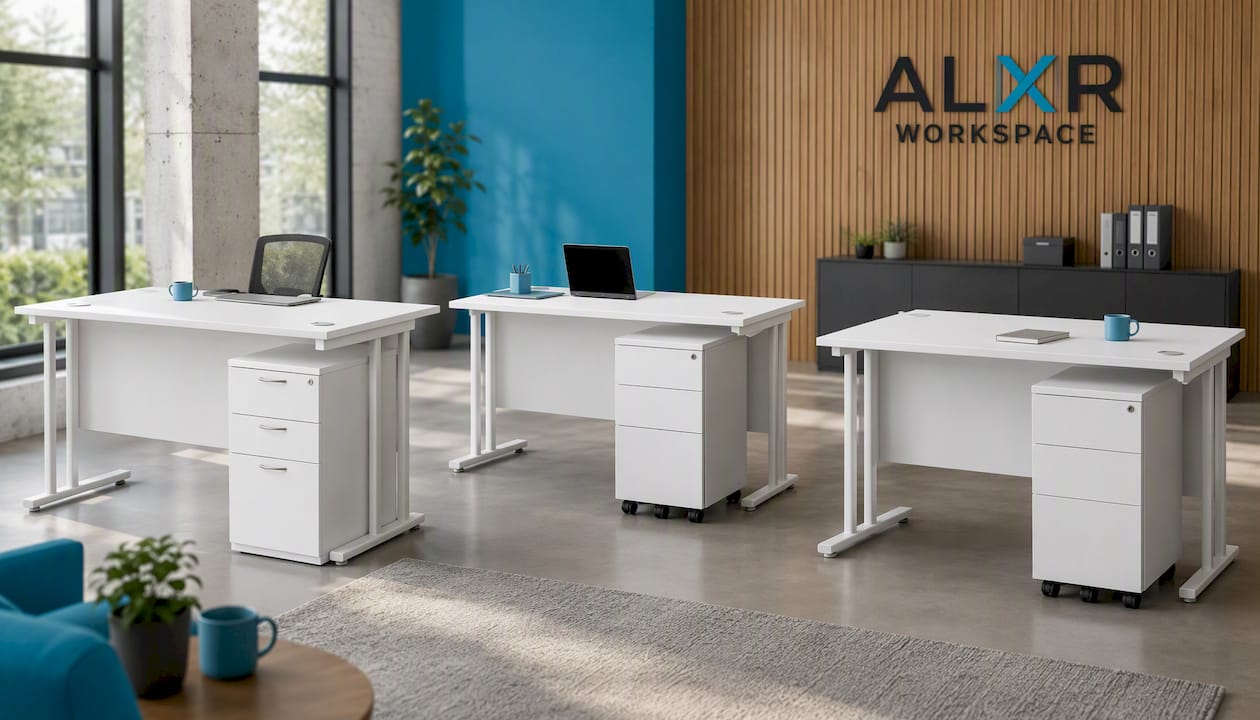
Three desking configurations from the current catalogue illustrate how stock and near-stock items fit into a realistic project schedule:
- Twin Upright Rectangular Desk + Slimline Steel Pedestal 3 Drawers (FSC) 800
- Twin Upright Rectangular Desk + High Mobile Pedestal 3 Drawer (FSC) 800
- Twin Upright Rectangular Desk + Slimline Steel Pedestal 3 Drawers (FSC) 600
Desking lines like these tend to sit at the faster end of the lead-time spectrum, which gives you room to absorb slower custom items elsewhere in the same scheme.
A practitioner’s checklist for procurement teams
Start three things this week: confirm live lead times on every long-lead item, name a decision owner for approvals, and lock your installation date so the calendar has an anchor. Involve design, procurement, and the installer early, with a 48-hour turnaround expected on sign-offs. Escalate immediately if a supplier goes quiet, a quoted date slips without explanation, or fabric approval stalls past a week.
— Syed
Alxr: lead-time certainty for your next fit-out
A reliable catalogue runs on the same principle this article recommends: check live lead times before you commit, and build in a buffer rather than hoping the quote holds. Nationwide delivery and installation come as standard, with warranty support behind every order, so a scheme built around these desking options doesn’t leave you managing multiple delivery windows against one installation date.
If you’re planning a desking refresh or a larger fit-out, start with a live lead-time check on the Twin Upright Rectangular Desk + Slimline Steel Pedestal 3 Drawers (FSC) 800, the High Mobile Pedestal version, or the compact 600 configuration. Get in touch for a site survey and a confirmed delivery date before you finalise your installation calendar.
Sources
- HSE — Room space and minimum distances
- Furniture lead times guide for interior designers (Procurist)
- Bob’s home office furniture — delivery times
FAQ
What is lead time in furniture?
Lead time is the full period from placing an order to receiving it on site, including manufacturing, quality checks, packing, transit, customs, and last-mile delivery, not just factory production time.
Why is furniture delivery so slow?
Factory order books, COM fabric sourcing, shipping method, customs paperwork, and internal approval cycles all stack up, which is why custom domestic pieces run 8 to 16 weeks and European imports often reach 12 to 24-plus weeks.
What is the minimum legal desk spacing in the UK?
There’s no fixed metric distance in law; HSE guidance requires enough free space for people to reach workstations and move about safely, with exact spacing determined by your layout design.
What should I do if furniture delivery is late?
Contact the supplier immediately for a revised confirmed date, activate any pre-approved alternate you’ve already agreed, and escalate to a decision owner if the delay threatens your installation slot. Suppliers that offer nationwide delivery and installation as one service reduce the number of parties you need to chase.
How much buffer should I add to a quoted lead time?
Add 4 to 6 weeks to your longest-lead item’s quoted time, then work your installation date backwards from that total rather than from the shortest item in the scheme.
Recommended
- Office Rectangular Desk with Steel Double Upright Cantilever Frame (FSC) | 1800X800 | Arctic White/Graphite
- Double Upright Left Hand Radial Desk + Desk High Pedestal (FSC) | 600mm Deep Pedestal | 1800X1200 | Alaskan Grey Oak/Graphite
- Office Rectangular Multi-Use Table (FSC) | 800X800 | Arctic White/Silver
- Office Rectangular Desk with Steel Double Upright Cantilever Legs + 3 Drawer Fixed Pedestal (FSC) | 1800X800 | Arctic White/White