

10–15 Minute Reset: School Storage Ideas for Busy Classrooms
Vertical shelving, tray systems, rolling trolleys, clear bins, and labelled cubbies deliver the biggest return for the least effort in most classrooms. Together, they free up floor space, cut daily tidy-up time, and let pupils fetch and return their own materials without asking you. Safety checks, low-cost hacks, and specific product options follow below.
TL;DR:
- Most effective classroom storage focuses on vertical, mobile, and easily accessible systems like trays, cubbies, and rolling carts to maximize space and efficiency.
- Maintaining a simple daily reset procedure and updating labels regularly is crucial for long-term storage system sustainability, especially beyond the first few weeks.
- Over-door pockets, magnetic strips, and wall-mounted shelves provide additional space without cluttering floors or corridors, suitable for fixed or reconfigurable layouts.
- In small or crowded classrooms, furniture that combines functions and vertical wall space can significantly improve storage capacity and reduce clutter.
- Regularly rotating resources, grouping by activity, and building routines around storage habits help sustain an organized classroom environment throughout the year.
Table of Contents
- School storage ideas that free up floor space fast
- Budget-friendly and DIY storage hacks
- Vertical and mobile solutions: installation and safety notes
- Organisation systems and labelling pupils can use
- Keeping storage working all year, not just in September
- Classroom-ready storage from the Titan range
- Storage for coats, backpacks, and lunchboxes
- Storage solutions for art, science, and music rooms
- Organising storage around learning centres
- Maximising storage in small or crowded classrooms
- Why most storage advice misses the maintenance problem
- Ready to fit out your classroom?
- Sources
- FAQ
School storage ideas that free up floor space fast
Getting classroom storage right is less about buying more furniture and more about matching the right system to how a space is actually used. Here are the ideas that hold up across a school year, not just on the first day of term.
-
Tray and trolley systems for daily resources. Position a tray unit near the door or the main work table, and keep trays shallow enough (under 8cm) that pupils can see contents at a glance. Curriculum resources that get used every day belong here, and not in a cupboard three metres away.
-
Student work bins and cubbies with name labels. Give every child a fixed slot and a simple turnover procedure, book bags in, finished work out, so the system runs itself once pupils learn the routine.
-
A classroom library with front-facing bins. Displaying book covers rather than spines, and rotating a portion of the stock termly, keeps the library looking fresh without buying new titles. Teacher-tested tips on front-facing book bins speed up both browsing and clean-up.
-
Rolling carts for small-group teaching. Load a cart with everything needed for a guided reading or maths intervention group, then park it against a wall, never across a walkway, when not in use.
-
Under-desk storage and mobile pedestals for teacher materials. A mobile pedestal keeps assessment papers and personal teaching resources close at hand but out of pupil reach, which matters for anything confidential.
-
Clear plastic boxes and stackable crates for manipulatives. Transparency does half the labelling work for you. Pupils can see there’s a gap where the counting cubes should be, which makes the return step almost automatic.
-
Charging stations with proper cable management. Group tablets and laptops in one bay with a cable tidy or box, rather than trailing wires across a desk, so devices charge overnight without becoming a trip hazard.
Budget-friendly and DIY storage hacks
You don’t need a large budget to run a tidy classroom. Some of the most effective solutions borrow from the kitchen cupboard, not the catalogue.
- Over-door shoe organisers turn into instant pigeonholes for scissors, glue sticks, and small stationery.
- Washed jam jars hold pencils, brushes, or counters on a shelf, and cost nothing beyond the washing-up.
- Cereal boxes cut at an angle become sturdy magazine files for worksheets and topic folders.
- Printed icons, washi tape, and simple clothes pegs make labels that survive a term of handling, far better than hand-written sticky notes.
- Buying one small, matched set of bins, even just five or six, creates a calmer look than a mismatched collection built up over years, and it’s often cheaper than replacing everything at once.
At the end of term, box up seasonal resources for off-site or home storage, but never leave sensitive electronics, chargers, or devices with batteries in an unheated store over the summer.
Pro Tip: Buy bins in one colour family rather than whatever’s on offer. A shelf of matching storage looks organised even on a chaotic Friday afternoon.
Vertical and mobile solutions: installation and safety notes
Wall space is often the most underused storage in a classroom. Wall pockets, magnetic strips, and hooks free up floor space that trolleys and bookcases would otherwise eat into, and they keep frequently used items visible and within reach.
Choose wall-mounted shelving when floor space is tight and the layout is fixed for the year; choose free-standing or mobile units when you need to reconfigure the room regularly or when children need to reach items independently — explore home organization systems to find fitted solutions tailored to your classroom needs.
- Standard classroom shelving anchored into studs typically holds a practical load of roughly 11 to 23kg per shelf, with spacing of 30 to 40cm working well for most educational resources.
- Always check fire-safety regulations with your site manager before installing anything at height, since local rules can prohibit shelving that obstructs exits, extinguishers, or alarm points.
- Park trolleys and mobile units against a wall or in a dedicated bay, never across a corridor, doorway, or fire escape route.
Organisation systems and labelling pupils can use
A storage system only works if pupils can operate it without you. Build it around a small number of repeatable habits rather than a fresh idea every term.
- Zone by activity. Group reading materials, art supplies, and maths resources into separate areas, and keep the layout consistent across similar zones so pupils build a mental map of where things live.
- Label with words and icons together. Pairing text with a simple picture helps early years pupils and multilingual learners locate and return items independently, without relying on reading ability alone.
- Rotate seasonal or unit-based resources. Swapping out display materials and topic boxes by term reduces visual clutter and keeps the room feeling refreshed rather than static.
- Use simple visual checklists. A laminated picture card by each shelf, showing what belongs there, cuts down on the “where does this go?” questions during tidy-up.
Keeping storage working all year, not just in September
The system that survives to July isn’t the most elaborate one, it’s the one your class can reset in ten minutes flat.
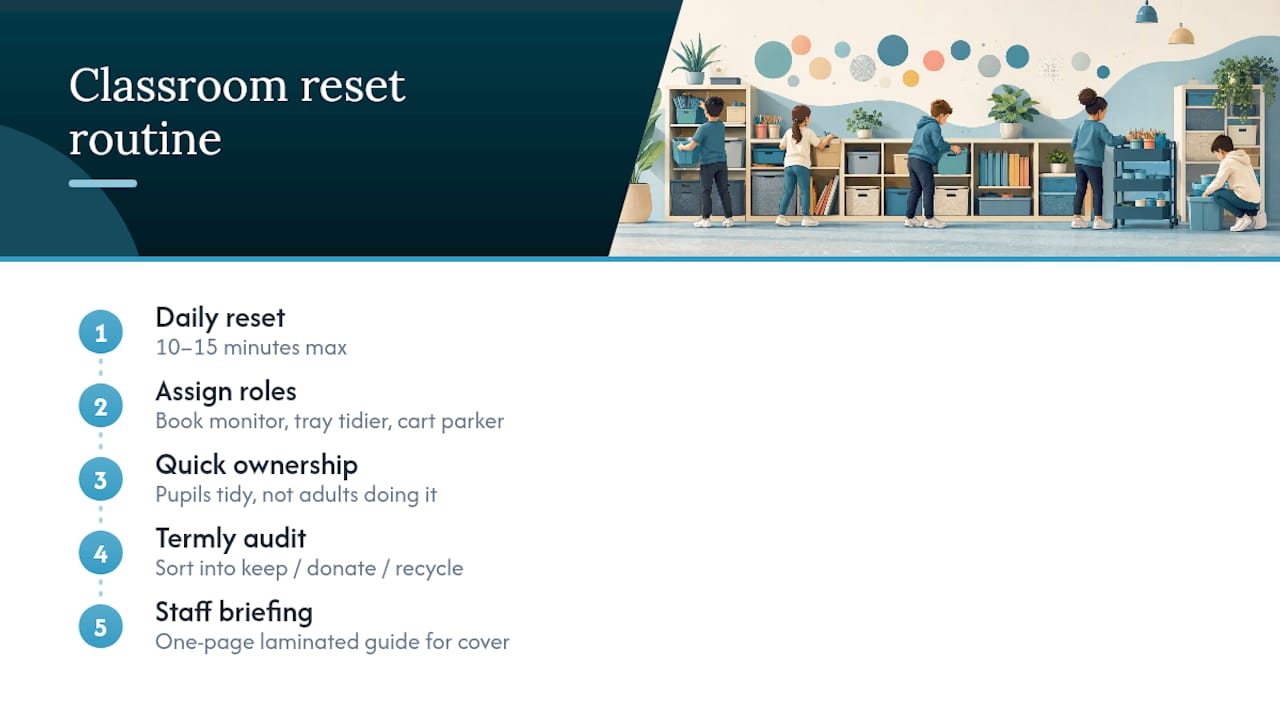
A daily reset capped at 10 to 15 minutes is the practical ceiling; anything longer tends to get skipped on a busy day, and once it’s skipped once, it slips further. Assign simple jobs, book monitor, tray tidier, cart parker, so pupils feel ownership rather than treating tidy-up as something done to them. Run a termly audit and sort everything into keep, donate, or recycle; anything unused for two terms rarely earns its shelf space back. Brief cover staff and teaching assistants on the system in writing, a one-page laminated guide works, so the routine survives when you’re not in the room.
Classroom-ready storage from the Titan range
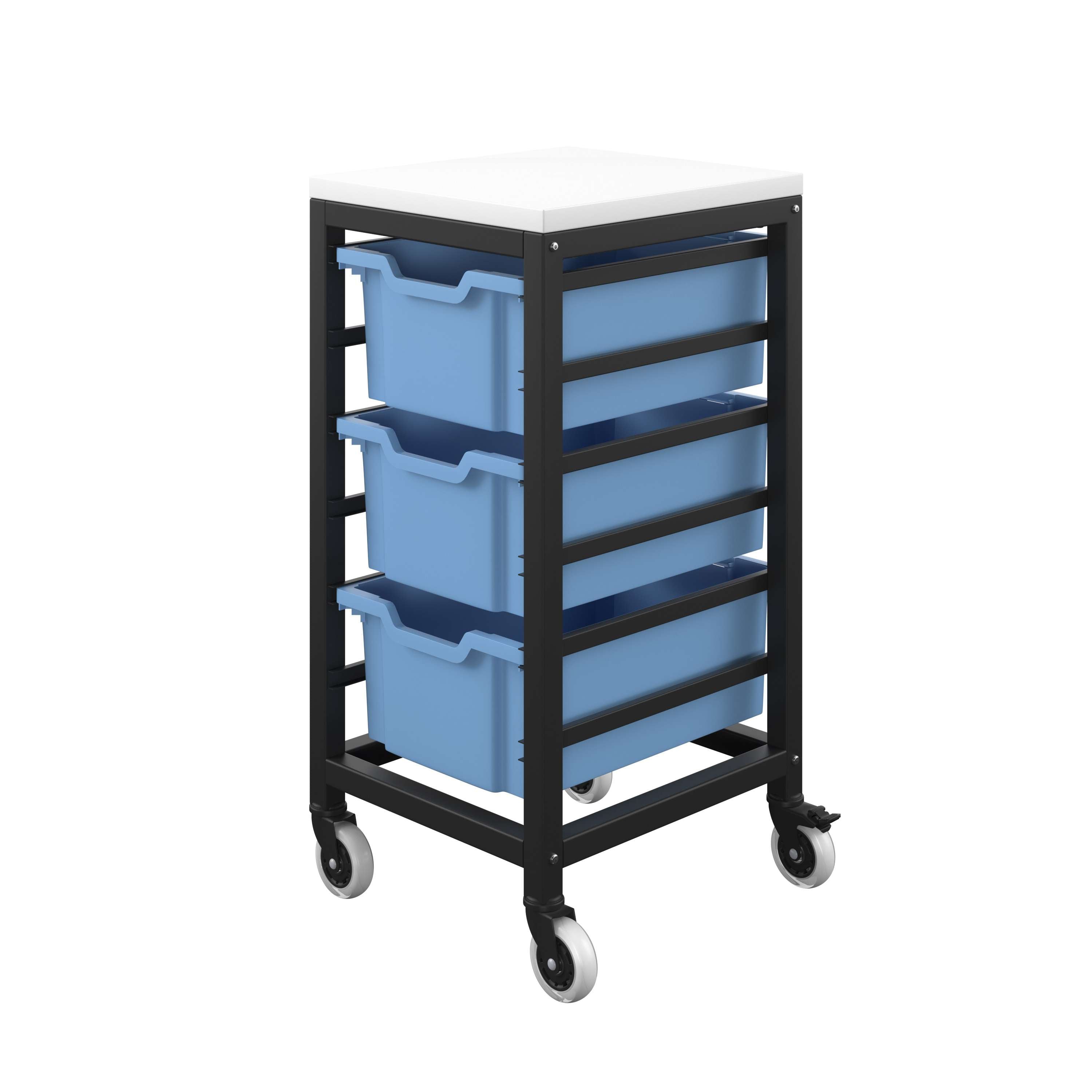
Some jobs are better solved with purpose-built furniture than a repurposed shoe organiser. The Titan Storage Unit with Tray Drawers slots straight into a tray-based workflow, sitting near the door or work tables where pupils collect and return resources daily.
- The Titan Storage Unit with Tray Drawers handles daily curriculum resources without the tray-depth guesswork.
- The Titan Teacher Wall Module 2 (FSC) gives an organised wall solution for classrooms with fixed layouts, though installation still needs a fire-safety check first.
- The Titan Stool doubles as compact seating and a supply-station perch for reading corners.
- As an NHS-approved supplier with nationwide delivery and installation, Alxr brings the same reliability schools need for procurement to classroom furniture.
Storage for coats, backpacks, and lunchboxes
Personal belongings cause more classroom clutter than curriculum resources, mostly because they arrive and leave at the same two chaotic points in the day: drop-off and home time. A dedicated cloakroom zone, hooks at child height with a name or picture label above each one, stops coats piling on chair backs and keeps fire exits clear of trailing straps.
Backpacks work best stored off the floor entirely. Cubbies or a low bench with hooks above it let pupils hang a bag rather than dump it, and it means the walkway between desks doesn’t fill up with straps and buckles by mid-morning. For lunchboxes, a separate crate or shelf near the door, ideally one that’s wipeable, keeps food items away from books and stationery, and makes the lunchtime collection process quicker because everything’s in one predictable place.
Younger classes benefit from colour-coded pegs matched to a reading group or table name, which speeds up the morning routine without needing an adult to direct traffic. Older pupils generally manage with a numbered peg and a five-minute settle-in routine at the start of the day. Whatever system you choose, keep it in the same spot all year. Moving the cloakroom zone mid-term undoes months of habit-building in a single week.
Storage solutions for art, science, and music rooms
Specialist rooms need storage that matches their mess, not a generic classroom template. Art rooms benefit from stackable, wipeable crates for paint pots and brushes, plus a drying rack or flat-file unit for wet or oversized work, since nothing derails a lesson faster than nowhere to put finished paintings. Open shelving with clear bins works well for paper and card sorted by colour, because pupils can grab what they need without rifling through drawers.
Science storage carries different demands entirely. Chemicals and any hazardous materials need lockable cabinets, kept separate from general equipment, with clear signage and restricted access. Everyday kit, magnifying glasses, measuring cylinders, safety goggles, sits better in labelled trays on open shelving so pupils can self-serve during practicals without an adult fetching each item.
Music rooms tend to fight a losing battle against irregular shapes. Wall-mounted hooks and pegboards suit smaller instruments and cables, while larger items, keyboards, percussion sets, need dedicated floor space or a rolling cart that tucks against a wall between lessons. Sheet music and books do well in slim, upright bins rather than flat stacks, which get damaged and disordered fast. In every specialist room, the storage should sit as close as possible to where the mess actually happens, cutting down on the walk between workstation and shelf that eats into lesson time.
Organising storage around learning centres
Learning centres and activity zones only run smoothly when the storage sits inside the zone, not across the room from it. A reading corner needs its book bins, cushions, and a small table within arm’s reach, so pupils settle in without wandering off to find a missing resource. A maths centre works best with manipulatives sorted by type in clear, stackable boxes, positioned right at the table where the activity happens, since a five-metre walk to fetch counting cubes is often enough to break concentration in younger pupils.
Rotating centres, where small groups move between stations, need storage that resets quickly between groups. This is where tray systems earn their keep: each group’s materials sit in a single tray that gets swapped rather than repacked from scratch. A five-minute changeover beats a fifteen-minute one every time, particularly in a school day already carved into short blocks.
Group work stations benefit from a shared caddy of pens, scissors, and glue kept at the table itself, rather than a central supplies cupboard that turns every task into a queue. Independent work areas need less variety but more discipline: one folder, one resource box, one place for finished work. The goal across every centre is the same. Storage should never be the reason a learning activity stalls, and it rarely needs to be if it’s positioned where the activity actually happens.
Maximising storage in small or crowded classrooms
Square footage is fixed, but usable storage rarely is. The first move in a cramped room is going vertical wherever wall space allows, since floor-standing units eat into the walking space pupils and staff need to move safely between desks.
Furniture that does two jobs earns its place fastest in a small room. A bench with storage underneath, a reading stool that also holds a stack of books, a desk with an integrated drawer, all reduce the number of separate units competing for the same square metre. Mobile units help too, provided they have a fixed home to return to once a lesson ends; a trolley that drifts wherever it was last used becomes another obstacle rather than a space-saver.
Doors and the backs of cupboards are free storage that most classrooms ignore. Over-door pockets and slim magnetic strips add capacity without touching the floor plan at all. In genuinely tight rooms, it’s worth being ruthless about what stays in the room permanently versus what moves to a shared corridor store or stockroom; not every resource needs to live where it’s used, only the ones needed daily. A crowded classroom with disciplined storage almost always feels larger than a spacious one with none.
Why most storage advice misses the maintenance problem
Most guidance on this topic focuses entirely on the initial setup, the trolley, the bins, the labels, and says almost nothing about what happens in November, when the novelty has worn off and the system either survives contact with a real school year or quietly collapses. That’s the gap worth closing.
The conventional advice treats storage as a one-off purchase decision. The stronger view, backed by how classrooms actually behave, is that storage is a routine you’re designing, not a shelf you’re buying. A trolley with no parking rule becomes clutter within a fortnight. A labelling system with no rotation plan becomes visual noise by half-term. The daily reset, capped at a strict ten to fifteen minutes, is the single most underrated lever in this whole topic, because it’s the difference between a system pupils maintain themselves and one that quietly becomes your job again by October.
Prioritise the boring parts first: a fixed home for every trolley, a labelling convention you’ll actually keep updating, and a job list that gives pupils real ownership. The furniture matters less than most guides suggest. The habit around it matters more.
— Syed
Ready to fit out your classroom?
Alxr is the practical route for schools who’ve already worked out what their classroom needs and just want it delivered and installed properly, rather than chasing separate suppliers for shelving, seating, and wall units. As a supplier, Alxr offers procurement reliability to school storage, with delivery and installation handled as part of the order.
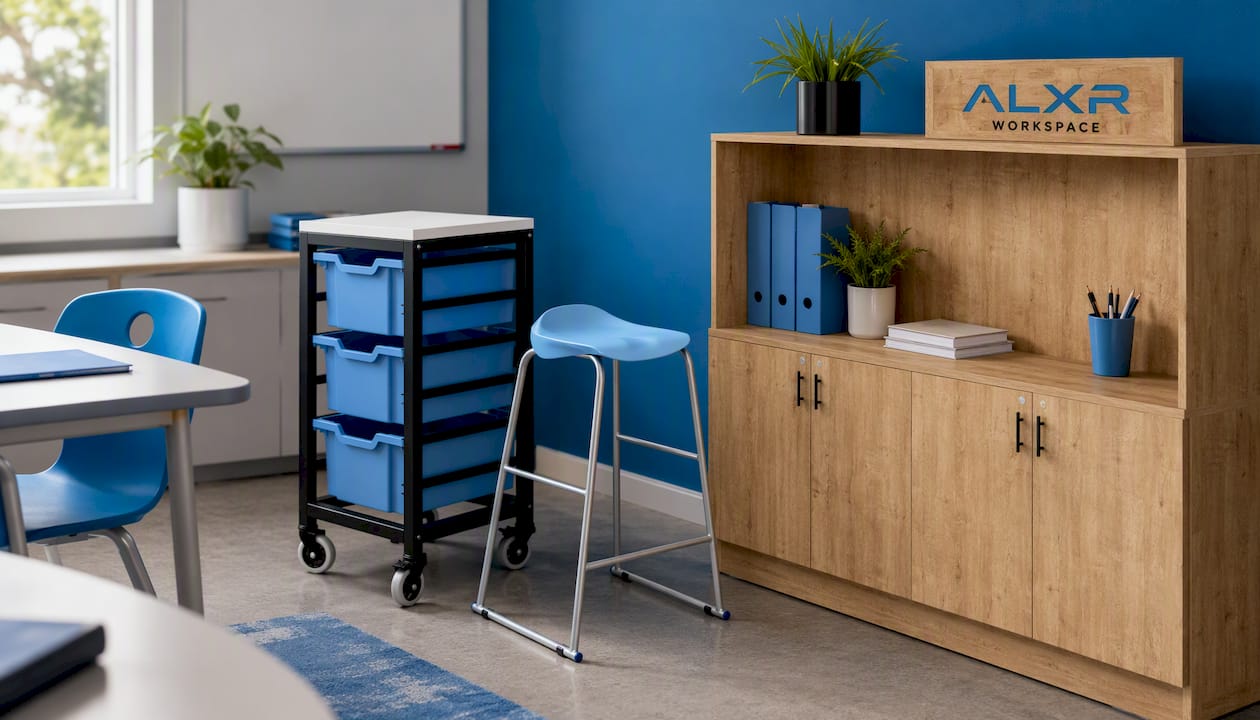
If tray-based workflows are your priority, the Titan Storage Unit with Tray Drawers is built for exactly that layout. For wall-mounted classroom storage, the Titan Teacher Wall Module 2 covers the vertical solution discussed earlier, installation guidance included. Browse the full workspace storage range to request a quote or arrange delivery and installation for your school.
Sources
- 7 steps to make organizing your classroom simple | Heinemann
- Tips for Organizing Your Classroom at the Beginning of the School Year | Scholastic
- 20+ Genius Classroom Organization Ideas for Teachers in 2026 - Teacher Strategies
FAQ
What are some clever storage ideas for schoolwork?
Front-facing book bins, labelled tray systems, and rotating unit-based resource boxes keep schoolwork visible and easy to return, cutting down on lost worksheets and mixed-up folders.
What are some inexpensive classroom storage ideas?
Repurposed shoe organisers, washed jam jars, and cereal-box magazine files cost almost nothing and work as well as bought equivalents for pencils, small stationery, and paperwork.
What are some good storage ideas for students?
Named cubbies for personal belongings, clear bins for manipulatives, and a consistent zone-based layout let students fetch and return their own materials without asking a teacher.
What are some creative hidden storage ideas?
Over-door pockets, under-bench compartments, and mobile pedestals like the under-desk storage unit tuck resources out of sight while keeping them within easy reach for staff.
How do I keep a classroom storage system working all year?
Cap the daily reset at 10 to 15 minutes, assign pupils simple storage jobs, and run a termly audit to keep, donate, or recycle anything that’s gone unused for two terms.