

2–3 Finger Gap: Set Seat Depth Adjustment Right for UK Offices
The correct seat depth leaves a gap of about two to three fingers, roughly 5cm, between the front edge of the seat and the back of your knees. Set your seat height first, then adjust depth using the sliding pan or backrest control your chair provides. Get this order right and everything else about your sitting posture falls into place far more easily.
TL;DR:
- Chairs with adjustable seat depth should have a range of at least 1 to 4 inches, ideally listed explicitly in the specifications, to accommodate different body types.
- Proper seat depth ensures your fingers can fit between the seat front and the back of your knees, preventing circulation restrictions and support issues.
- Adjusting seat height first to achieve a 90-degree knee angle is essential before fine-tuning the depth for optimal comfort and posture.
- If your chair lacks a sliding pan, adding lumbar support or a footrest can improve thigh support or compensate for a fixed, shallow seat.
- Regular maintenance like cleaning rails and tightening fasteners can keep the depth adjustment mechanism functioning reliably over time.
Table of Contents
- What is seat depth and how do you measure it?
- Why does correct seat depth actually matter?
- Which adjustment mechanism does your chair use?
- How do you adjust seat depth step by step?
- What if your chair has no seat depth adjustment?
- Why does my seat depth adjustment feel loose or wrong?
- How does ALXR help you get seat depth right?
- How do seat depth features compare across chair types?
- How do you keep the adjustment mechanism working long term?
- Why the adjustment order is the part people skip
- Find the right seat depth adjustment with ALXR
- Sources
- FAQ
What is seat depth and how do you measure it?
Seat depth is not the same as overall chair depth. Overall depth includes the backrest and any padding behind it; seat depth is the usable length of the pan itself, measured from the front face of the backrest to the front edge of the cushion. That distinction matters because a chair listed as “deep” on a spec sheet might still have a perfectly adjustable seat pan.
To measure what you actually need, sit upright on a firm surface and measure from the back of your buttocks to the back of your knee, then subtract 1 to 2 inches. That gives you a target seat depth suited to your own seated thigh length.
Once seated in the chair itself, run the quicker version:
- Slide fully back so your lower back meets the backrest
- Slot two or three fingers between the seat edge and the back of your knee
- If your fingers barely fit or you feel pressure, the seat is too deep
- If there’s a large gap, the seat is too shallow and your thighs are under-supported
Why does correct seat depth actually matter?
A seat that’s too deep pushes the front edge into the back of your knees, which restricts circulation, causes numbness in the calves, and often forces you to slide forward off the backrest just to get comfortable. Ironically, the “correction” people make when this happens (perching on the front third of the seat) removes lumbar contact entirely and puts more strain on the lower back than sitting badly in the first place.
A seat that’s too shallow does the opposite kind of damage. Your thighs lose support along most of their length, which tires the legs faster and encourages you to shift position constantly.
Seat depth is one of the most overlooked chair specifications, yet getting it wrong produces exactly these pressure and circulation problems. Correct depth is also what makes the 90-90-90 position achievable: hips, knees, and ankles all near 90 degrees, with lumbar support actually reaching your lower back rather than your mid-spine.
Which adjustment mechanism does your chair use?
Most ergonomic chairs use one of three systems, and knowing which one you have decides how you’ll actually make the adjustment.
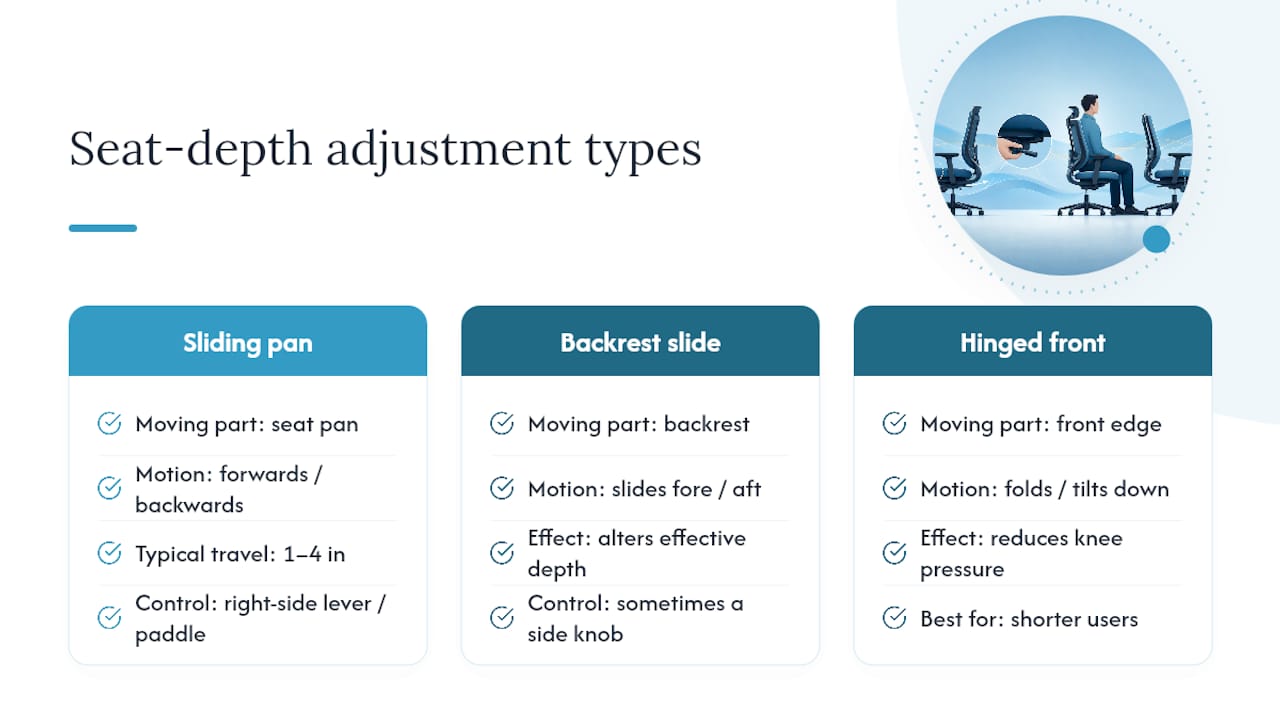
Sliding seat pan. The cushion itself moves forward and backward along rails underneath, usually released by a lever or paddle on the right side of the seat. Typical travel is 1 to 4 inches, which covers most adult body shapes without needing a specialist model.
Adjustable backrest position. Rather than the pan moving, the backrest slides closer to or further from the front edge, thereby changing your effective seat depth without touching the cushion itself. Some specialist seating systems take alternative approaches entirely, using shaped or hinged seat sections instead of a simple sliding mechanism.
Hinged or waterfall front edge. A small hinge lets the front of the seat pan curve downward, reducing pressure behind the knee even when depth itself isn’t adjustable. This helps shorter users more than it solves genuine depth mismatch.
To find your control, check under the front right of the seat pan for a lever, or look for a small knob at the seat’s side edge. Chairs without any visible control usually have fixed depth.
How do you adjust seat depth step by step?
Adjust in this order, every time: height, then depth, then lumbar and armrests. Skipping ahead to depth before your feet are flat on the floor gives you a false reference point and you’ll end up readjusting everything twice.
- Set seat height first. Sit down and adjust until your feet rest flat on the floor with knees at roughly 90 degrees. This is the foundation everything else is measured against.
- Sit fully back. Slide your hips as far back as they’ll go so your lower back meets the lumbar support. This is your reference position for depth.
- Locate and operate the depth control. Most manufacturers recommend making this adjustment while seated, so the mechanism responds to your actual weight distribution rather than an empty chair.
- Aim for the two to three finger gap. Slide the pan or backrest until you hit that target, then lock the mechanism securely. A gap that isn’t locked will creep during the day.
- Test for five to ten minutes and fine-tune. Type, reach for a phone, lean back. If pressure builds behind your knees, ease the seat back a fraction; if your thighs feel unsupported, bring it in.
Only once depth feels settled should you move on to lumbar height and armrest position, both of which depend on the seat depth being correct first.
Pro Tip: Do this adjustment at the end of the day rather than first thing in the morning. Your body settles slightly after hours of sitting, and the fit you find late afternoon tends to hold up better than one set on a fresh, upright frame.
What if your chair has no seat depth adjustment?
Plenty of budget and mid-range chairs simply don’t offer a sliding pan, and that’s not the end of the road, just a more limited set of options.
- Add a lumbar roll or rolled towel behind your lower back to push your hips forward, effectively shortening the usable depth without touching the chair itself.
- Lower the seat slightly if your thighs are unsupported at a shallow depth. This trades a little knee angle for better thigh contact.
- Add a footrest if lowering the seat drops your feet below a comfortable angle.
- Check whether replacement is genuinely necessary. A lumbar roll is a cheap, reversible test that tells you whether a shallower effective seat solves the problem before you spend money on a new chair.
If none of these close the gap, the seat is likely too shallow for your frame and a fixed pan can’t fix that. When shopping for a replacement, check the spec sheet for a published seat depth range, not just a single figure. Many listings only quote overall depth, which tells you nothing about the usable pan, so look for products that state the adjustable range explicitly.
Why does my seat depth adjustment feel loose or wrong?
A depth mechanism that slips mid-task or locks unevenly is usually a maintenance issue rather than a design flaw, and most causes are simple to check.
- Test the lock itself. Sit down, apply weight, and try to slide the pan. If it moves under normal sitting pressure, the locking pin or lever isn’t engaging fully.
- Check for debris in the rails. Dust and grit under the seat pan are a common cause of stiff or uneven sliding, especially in chairs that have been in continuous use for a year or more.
- Look at visible fasteners. Loose screws where the pan meets the rail frame often show up as a slight rocking motion before the mechanism fails outright.
- Try small comfort tweaks first. A slight seat tilt or a thin cushion can resolve minor pressure points without touching the mechanism at all.
Pro Tip: If a lever feels stiff rather than loose, don’t force it. A mechanism that’s binding rather than sliding freely is often close to failing, and forcing it tends to strip the internal ratchet.
If tightening and cleaning don’t resolve it, this is a warranty or servicing matter rather than something to keep working around.
How does ALXR help you get seat depth right?
ALXR supplies over 10,000 precision-designed workplace products, including a range of ergonomic seating with independent height and depth adjustment, and is an NHS-approved supplier trusted across healthcare, education, and commercial settings. Chairs such as the ergonomic posture chair with height and depth adjustable arms are built around exactly the finger-gap fit described above. Nationwide delivery and installation come as standard, backed by warranty support, so getting the fit right doesn’t rest entirely on guesswork through a spec sheet.
How do seat depth features compare across chair types?
Not every chair category treats depth the same way, and knowing where a design sits helps you judge whether it will actually fit before you buy it.
Entry-level task chairs rarely offer a sliding pan at all. Depth is fixed, and the only realistic adjustments are seat height and sometimes backrest tilt. These work fine for users who happen to fall in the middle of the sizing range, but offer nothing for anyone at either end of it.
Mid-range ergonomic chairs typically add a lever-operated sliding pan with 1 to 3 inches of travel, enough to accommodate most adult body types without needing a specialist model. This is where you’ll find models like the deluxe ergonomic posture chair with height and depth adjustable arms, which pairs a sliding pan with independently adjustable arms so the whole chair moves with you rather than forcing one fixed shape.
Higher-spec and healthcare-grade seating often goes further, combining seat depth adjustment with waterfall front edges and multi-position backrests, useful in clinical or long-shift environments where several people share one chair across a day. Products like the ID ergonomic office chair sit in this bracket, built to hold their adjustment settings reliably across repeated use.
Fixed-shell seating, tub chairs and reception-style pieces, generally skips depth adjustment altogether, since these are designed for shorter periods of sitting rather than a full working day. If you’re setting up a shared or multi-user workspace, checking which category each chair falls into before ordering saves a lot of after-the-fact adjustment headaches. For a fuller look at how depth interacts with the rest of your setup, ALXR’s guide to why the right chair matters covers height, lumbar position, and monitor placement together.
How do you keep the adjustment mechanism working long term?
A seat depth mechanism is a mechanical system with moving rails, a locking pin, and usually a spring-loaded lever, and like any mechanical system it degrades faster under neglect than under use.
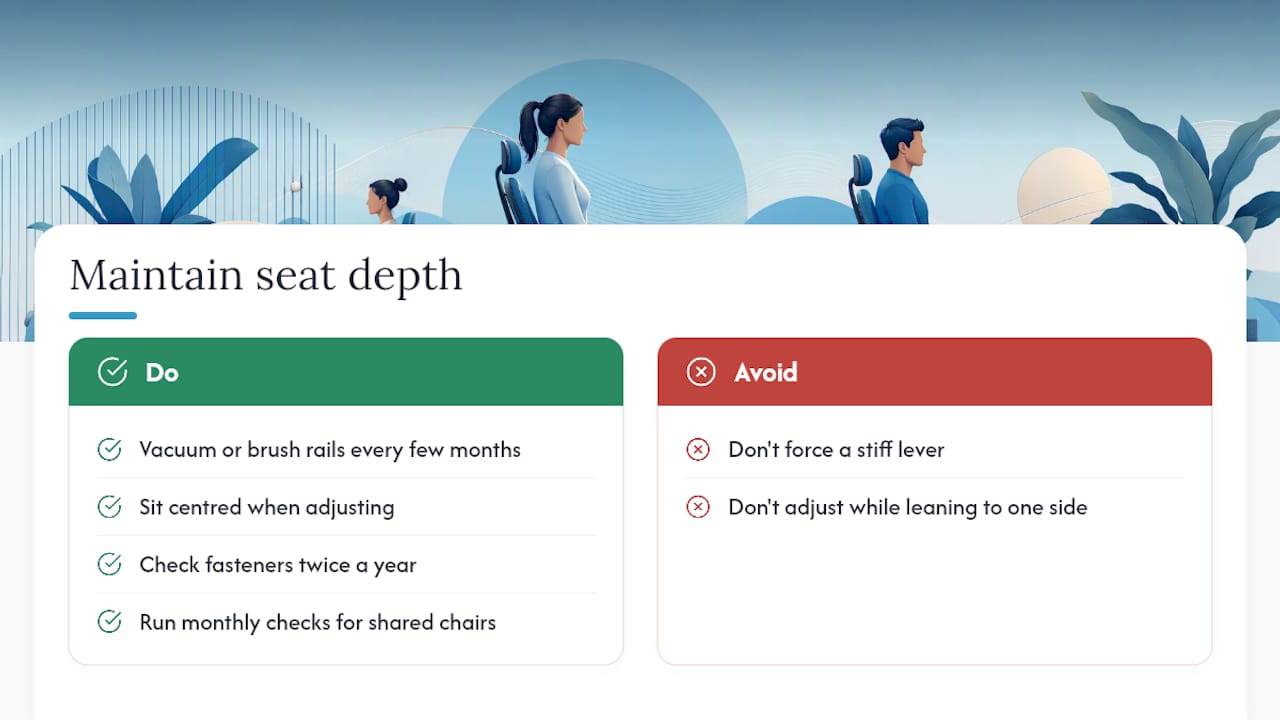
Vacuum or brush out the rail channel under the seat pan every few months. Dust, crumbs, and fabric fibres build up in exactly the groove the mechanism needs to slide through, and this is the single most common cause of stiff or sticking depth adjustment. A can of compressed air works well if the gap is too narrow for a vacuum nozzle.
Avoid adjusting the depth while leaning heavily to one side. Uneven weight distribution during the adjustment itself puts sideways stress on rails designed to move front to back, and over months this can bend the guide or wear it unevenly. Sit centred, apply the lever, then settle back into position.
Check fasteners twice a year. Screws holding the pan to the rail frame loosen gradually with vibration and regular sitting weight, and a quarter turn with an Allen key or screwdriver every six months prevents the wobble that eventually turns into failure.
Don’t force a stiff lever. If the mechanism resists movement, stop and inspect for debris or a bent rail before pushing through it, since forcing a binding mechanism is the fastest way to strip the internal ratchet permanently.
For chairs used across multiple shifts or shared by several people in healthcare or education settings, build a quick monthly check into general workplace maintenance. Catching a loose fastener early is a five minute fix; replacing a failed rail assembly is not.
Why the adjustment order is the part people skip
Most people adjust their chair once, on the day it arrives, and never touch it again. That’s the real failure point, not the mechanism itself. Seat depth interacts with height, and height interacts with desk position, so treating any one setting as permanent guarantees the other two eventually drift out of alignment too.
Three checks worth doing right now: sit back fully and check the finger gap without looking, stand up and sit down again to see if the seat height still puts your feet flat, and press your lower back into the lumbar support to confirm it’s actually making contact. If procurement or facilities are choosing chairs for a team, ask suppliers for the published seat pan range, not just overall depth, and confirm the adjustment can be made while seated rather than only from a manual.
— Syed
Find the right seat depth adjustment with ALXR
This supplier offers a direct route to fixing seat depth properly, without the trial-and-error of guessing at specs from a listing photo. If your current chair has no sliding pan and a lumbar roll hasn’t solved the pressure behind your knees, the Titan Junior Shell Seatpad and Titan Seat Pad both adjust how your body sits against the existing frame, a lower-cost step before a full chair replacement.

For seating with a genuinely different geometry, the Tub Armchair with Metal Feet suits users whose proportions don’t fit standard task-chair depth ranges. Every option comes with nationwide delivery and installation, backed by warranty support and NHS-approved supply standards. If you’re fitting out more than a single desk, request a site survey and let the supplier match seat depth ranges to your team before you order, rather than after.
Sources
The measurement method and finger-gap test in this guide draw on Office Chair Seat Depth: How to Get It Right, which covers sliding pan mechanisms and typical travel ranges in detail. For the physiological effects of poor seat depth, What Is Seat Depth? A Complete Guide to Proper Ergonomic Fit explains circulation and pressure point risks. Broader workplace ergonomics context comes from Open Access Government’s overview of ergonomic furniture benefits.
- Office Chair Seat Depth: How to Get It Right (2026)
- What Is Seat Depth? A Complete Guide to Proper Ergonomic Fit (2026)
FAQ
How do I adjust the seat depth on my chair?
Set your seat height first, sit fully back against the lumbar support, then operate the sliding pan lever or backrest control while seated until you have a two to three finger gap behind your knees, then lock the mechanism.
What is the 90-90-90 rule for sitting?
It describes hips, knees, and ankles each positioned at roughly 90 degrees, a posture that’s only achievable when seat height and seat depth are both correctly set together.
How do I increase seat depth if my chair feels too shallow?
Check whether your chair’s sliding pan has room to extend further forward; if it’s already at maximum or has no adjustment, a lumbar roll removed and a slight seat lowering can improve thigh support, though a genuinely shallow fixed seat usually needs replacing.
What happens if my seat depth is too short?
A seat that’s too shallow leaves your thighs unsupported along most of their length, which tires the legs faster and often causes constant shifting and reduced lower back contact with the backrest.
Do all ergonomic chairs have seat depth adjustment?
No, many entry-level chairs have a fixed pan; adjustable depth is more common in mid-range and higher-spec ergonomic seating, including several ALXR models with independent height and depth controls.