

Procurement Checklist: Modular Office Seating and Alxr Solutions
Modular office seating is the right call whenever a space needs to work two or three different ways without a refit. Buy modules that link, dismantle and re-form, specify commercial-grade upholstery and a proper linking system, and you get a reception, breakout, or collaboration zone that grows with the business instead of being replaced by it. Alxr supplies and installs these systems nationwide, with warranty backup once they’re in.
TL;DR:
- Modular seating allows for flexible layouts that can be easily reconfigured to suit changing workspace activity types and occupant needs.
- High abrasion resistance fabric and resilient foam are essential for durability in commercial settings, with suppliers recommended to provide specific ratings in writing.
- Proper planning of space, circulation, and occupant density prevents inefficient use and costly rearrangements once modules are installed.
- Regular maintenance, including cleaning and checking fixings, extends lifecycle and maintains safety, especially in high-footfall breakout zones.
- Sustainability benefits stem from replaceable components, environmentally certified materials, and long-lasting, high-quality modules that reduce waste over their lifespan.
Table of Contents
- What are the main modular office seating configurations?
- Which materials and upholstery grades hold up best?
- How do you choose modular seating and brief suppliers properly?
- What happens during ordering, delivery, and installation?
- How Alxr’s catalogue and services meet the checklist
- What ergonomic and health factors should you consider?
- What customisation options are available?
- How do you maintain modular seating to extend its life?
- Is modular office seating a sustainable choice?
- A short first-person design view from Alxr
- How Alxr can help: catalogue, space planning and installation
- Selected manufacturer pages and collections for technical reference
- Sources
What are the main modular office seating configurations?
Modular seating comes down to five building blocks: single seats, corner units, curved sections, bench modules, and linking tables that bolt between them. Mix and match these, and you can build almost any layout a workplace designer would sketch on a whiteboard.
Manufacturers design these components to be assembled, taken apart, and reconfigured repeatedly rather than fixed in place. Sedus’s se:works range is built on exactly this principle, using linking mechanisms that let individual elements move as a team’s needs shift. Other systems go further, allowing extra backrests, armrests, or linking tables to be added later, with dimensions specified down to fine increments so a run of seating fits a wall or window bay precisely, as seen in Lammhults’ Teius range.
The layout you choose depends entirely on the activity it needs to host:
- Linear runs against a wall or window suit reception areas and transient waiting, where sightlines to a desk or door matter more than privacy.
- Curved sections work best for informal collaboration, since the shape naturally angles people towards each other without forcing eye contact.
- Island clusters in the centre of a breakout zone create a destination for spontaneous meetings, particularly when paired with a low linking table.
- Bench clusters with shared tables suit high-turnover collaboration spaces, such as project rooms used by rotating teams.
- Quiet nooks, often a single seat or two-seat module tucked against a wall or partition, give people a place to take a call or focus without booking a room.
Space planning matters as much as the modules themselves. Leave ample clear circulation past any seating run, keep sightlines open in reception zones so visitors aren’t disoriented, and plan occupant density conservatively. A breakout island designed for multiple users rarely performs at full capacity in daily use, once bags, laptops, and coats claim their share of the space. Getting these calculations right before ordering saves a costly reshuffle later, and specialist guidance like Niche Advisory’s space-planning resources is worth consulting if the floorplan is unusual.
Which materials and upholstery grades hold up best?
Fabric choice is where a lot of procurement budgets quietly go wrong. Domestic-grade upholstery looks fine in a showroom but often fails quickly under commercial footfall, because it was never rated for that kind of use.
Commercial fabrics are rated on the Martindale abrasion test, and heavy-use breakout seating should specify a high abrasion resistance, paired with high-resilience (HR) foam rather than standard cold-cure (CR) foam. Sedus notes that this combination is what extends usable life and cuts down on whole-unit replacement, which matters when a single reception sofa can anchor a space for a decade.
Beyond abrasion, there’s a short list procurement should hold suppliers to:
- Stain resistance treatment, ideally a finish that survives repeated commercial cleaning without degrading.
- Fire performance certified to the relevant BS EN standard for contract furniture.
- Acoustic options, such as felt or upholstered screens, where breakout zones sit near open-plan desks.
- Replaceable parts, so a worn seat pad or scuffed leg doesn’t force replacement of the whole module.
Pro Tip: Ask for the Martindale rating and foam grade in writing on the quote, not just “commercial grade” as a marketing line. Suppliers who can’t produce the number usually haven’t tested for it.
How do you choose modular seating and brief suppliers properly?
A good procurement checklist starts with function, not fabric swatches. Work through these in order, and the supplier conversation gets much shorter.
- Define the function first. Is this reception, breakout, or a bookable collaboration zone? Each pulls towards a different module mix.
- Check the linking and assembly system. Ask exactly how modules connect, whether the mechanism is tool-free, and how long a reconfiguration takes on-site.
- Confirm integrated power and AV needs. Zones used for hybrid meetings increasingly need built-in sockets or USB points, a feature flexible workplace collections like Steelcase Flex treat as standard rather than optional.
- Factor in accessibility. Bench height and length should be specifiable, since modular bench systems that offer multiple seat heights make wheelchair access and mixed-mobility use far easier to plan for.
- Set a realistic budget band. Entry-range modular seating covers basic linked benches with standard fabric; mid-range adds curved sections, better foam grades, and acoustic screens; premium ranges bring integrated power, bespoke fabric (COM), and higher Martindale ratings.
When briefing suppliers, ask about lead times, installation scope, spare-part availability, and what the warranty actually covers once the seating is in daily use. Red flags worth walking away from: non-commercial upholstery dressed up as contract-grade, no written warranty, a linking system nobody can explain clearly, and no promise of spare parts down the line.
What happens during ordering, delivery, and installation?
Standard modular ranges typically ship faster than bespoke ones. Anything involving custom fabric, client’s own material (COM), or integrated power tends to add weeks rather than days to the lead time, so flag those requirements at quote stage rather than after the order is placed.
Installation usually covers more than most procurement teams expect, but not everything:
- Linking, levelling, and fixing modules together on-site is standard.
- Minor power works, such as connecting pre-wired sockets, are often included.
- Full electrical first-fix or structural work usually costs extra and needs a separate quote.
- Removal and disposal of old furniture is sometimes bundled, sometimes not, so confirm it upfront.
Ask about aftercare too. On-site repair visits, guaranteed spare-part stock, and support for future reconfiguration are the three things that separate a supplier who disappears after delivery from one who doesn’t.
How Alxr’s catalogue and services meet the checklist
Alxr is an NHS-approved supplier, which reflects the kind of durability and compliance standard the checklist above demands, and delivery and installation run nationwide with warranty support built in.
The catalogue includes pieces that slot directly into a modular plan:
- The Vision Mesh Office Chair works well in collaboration zones needing individual, mobile seating alongside fixed modules.
- The Under Desk Linking Mechanism Black (Pair) (FSC) secures adjoining desks in benching layouts, giving the same physical stability a good seating linking system provides.
- The Twin Upright Rectangular Desk + Mobile 2 Drawer Pedestal (FSC) 800 pairs with modular lounge seating to turn a breakout corner into a functioning workstation cluster when needed.
Spare parts, retrofit accessories, and space-planning support round out the offer, so a layout can evolve without a full replacement order.
What ergonomic and health factors should you consider?
Modular seating isn’t just a space-planning tool. Poor seating posture over a working day contributes to musculoskeletal strain, and breakout furniture gets used for longer stretches than people assume, often for calls, laptop work, or informal meetings that run past twenty minutes.
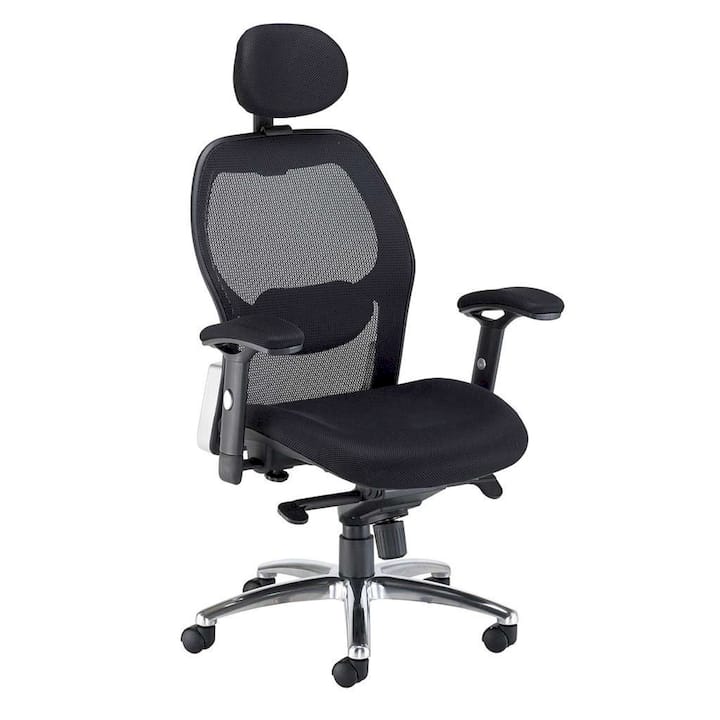
Look for modules with genuine lumbar support in any seat intended for extended use, not just decorative shaping. Seat depth matters too: a module too deep for shorter occupants forces slouching, while one too shallow gives no thigh support at all. Where a breakout zone doubles as informal workspace, pairing lounge seating with a height-adjustable desk gives people the option to stand and reset posture rather than staying seated for hours.
Foam grade plays into comfort as much as durability. HR foam holds its shape under repeated sitting and standing far better than budget CR foam, which flattens and stops supporting the body correctly within a year or two of heavy use. That flattening is often the real reason a “worn out” sofa gets replaced, not the fabric.
Height variation across a seating run also helps different body types and needs, including wheelchair users and taller or shorter staff, use the same zone comfortably. This is worth reading as part of a wider wellbeing strategy, and the case for height-adjustable furniture reducing prolonged sitting risks applies just as much to breakout zones as it does to individual desks.
What customisation options are available?
Customisation is where modular seating earns its name. Because modules are engineered to accept add-ons, procurement isn’t locked into whatever configuration ships from the factory.
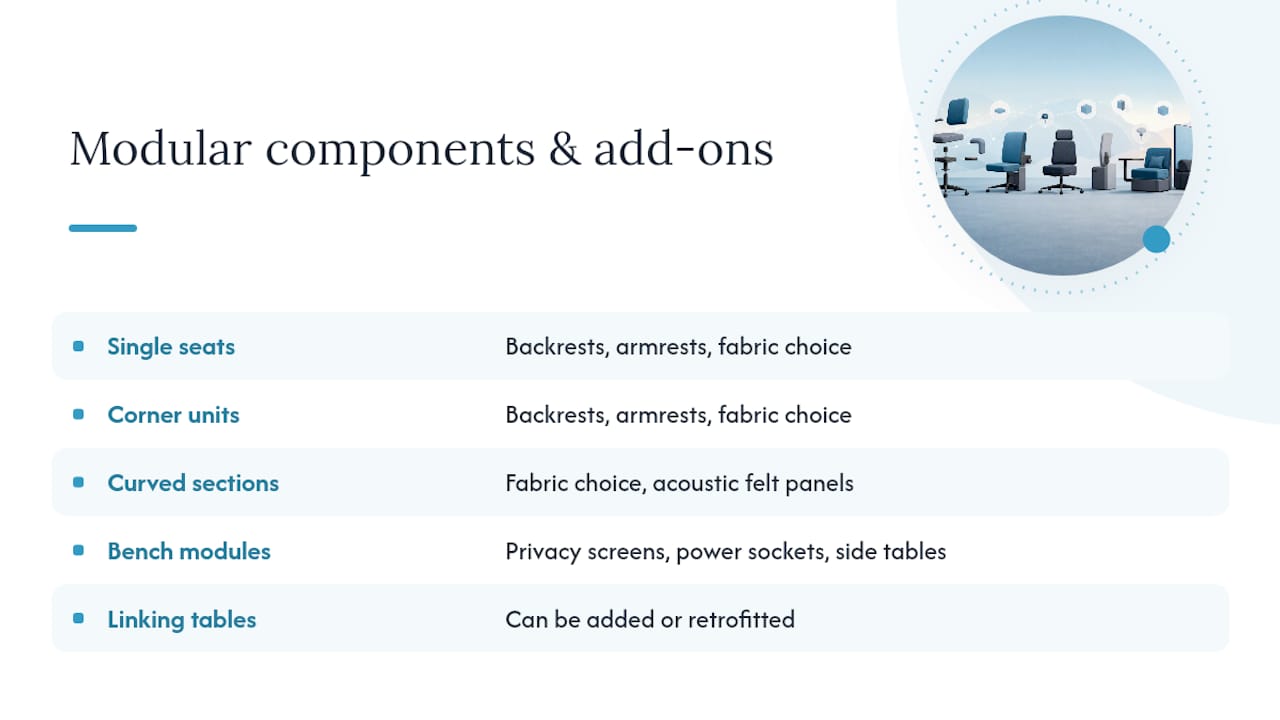
Backrests, armrests, and linking tables can typically be added after the initial installation, and dimensions can often be ordered to fine tolerances so a run fits an awkward alcove or column-interrupted wall exactly, a level of precision Lammhults’ Teius system is specifically built to support. Fabric choice extends customisation further: two zones built from the same base module can look completely different depending on colourway, or one can carry acoustic felt panels while the other stays open.
Accessories add function rather than just style. Privacy screens, integrated power sockets, and attachable side tables can often be retrofitted onto existing modules rather than requiring new units, which Sedus’s product documentation lists as standard accessory options across its modular range. That retrofit capability matters most a year or two after installation, when a breakout zone’s actual use has settled into a pattern nobody predicted at the design stage.
Mixed-mode setups are increasingly common too, where seating modules sit alongside height-adjustable surfaces so the same footprint supports both a quick seated chat and a standing huddle, an approach reflected in flexible workstation concepts like Sunon’s MixCube. Customisation, in other words, isn’t a one-off decision made at purchase. It’s an ongoing option, provided the base system was specified with that flexibility in mind.
How do you maintain modular seating to extend its life?
Cleaning routine matters more for modular seating than for a single feature sofa, simply because breakout zones see far higher footfall relative to their size.
Wipe-down fabrics should be cleaned with manufacturer-approved products weekly in high-traffic zones, since generic cleaning chemicals can strip stain-resistant treatments faster than the fabric would otherwise wear. Vacuum upholstered surfaces regularly to stop grit working into the weave, where it acts like sandpaper on fibres every time someone sits down.
Check linking mechanisms and fixings every few months. A loose linking bracket doesn’t just create a wobble, it puts uneven strain on the module joints either side, which shortens the life of components that would otherwise last years. Foam should be checked for permanent compression too. If a cushion doesn’t spring back within a few seconds of standing up, it has likely lost its resilience and is due for replacement rather than the whole module.
Rotate cushions and seat pads where the design allows it, spreading wear more evenly across a bench run instead of letting the busiest section fail first. And keep a small stock of common spare parts, glides, fixings, minor trim pieces, on hand, since a five-minute fix delays a much bigger repair bill later.
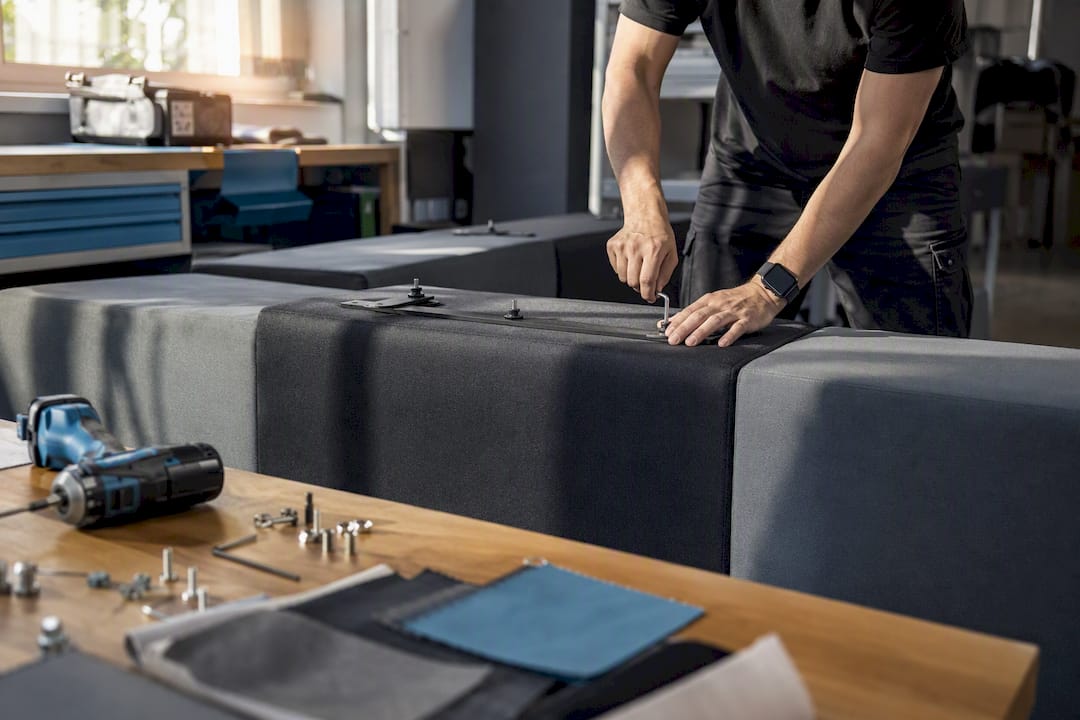
Set a simple maintenance calendar and stick to it. Modular systems reward this kind of routine attention precisely because their components are replaceable rather than disposable, which is the entire point of specifying them in the first place.
Is modular office seating a sustainable choice?
Sustainability in modular seating comes down to one structural advantage: components can be replaced individually rather than sending an entire unit to landfill because one cushion wore out.
That retrofit-first design, upholstery, legs, screens, and power modules built to be swapped rather than fixed, cuts material waste significantly over a product’s working life. It also means a breakout zone can be updated stylistically, new fabric, added screens, a different table, without a full furniture replacement cycle, which reduces both cost and environmental impact at once.
Material sourcing matters too. FSC-certified timber components, recyclable foam where available, and fabrics free from harmful chemical treatments all reduce the environmental footprint of a seating scheme before it ever reaches the office. Look for suppliers who can confirm certification on request rather than relying on vague sustainability claims with no paperwork behind them.
Longevity itself is a sustainability metric that’s easy to overlook. A well-specified module with heavy-commercial upholstery and HR foam that lasts a decade beats a cheaper unit replaced every three years, even if the cheaper option looked greener on paper at the point of purchase. Total lifecycle impact, not sticker price or marketing language, is the number that actually counts.
A short first-person design view from Alxr
If a workplace is starting from scratch, I’d recommend a mixed layout: a curved cluster for informal collaboration, a linear bench run near reception, and one or two quiet single-seat nooks. This spread covers the widest range of daily activity without overcommitting budget to any one zone.
It balances flexibility, cost, and comfort better than betting everything on a single configuration, because most workplaces don’t yet know exactly how a breakout space will be used until people start using it.
— Syed
How Alxr can help: catalogue, space planning and installation
Alxr is the practical alternative to piecing a modular scheme together from several suppliers. One catalogue covers seating, linking accessories, and desking, backed by nationwide delivery, installation, and warranty support, so there’s no gap in accountability if something needs fixing six months in.
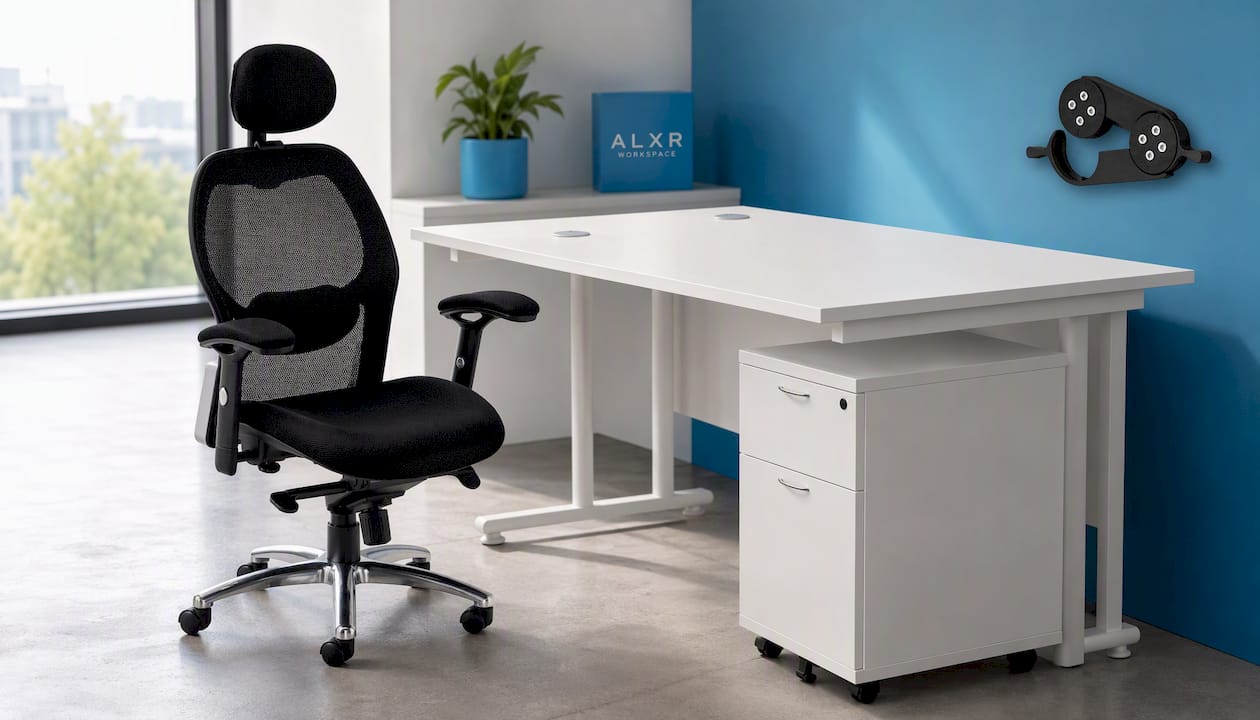
Beyond off-the-shelf modules, Alxr offers space-planning input to help translate a floorplan into an actual layout, whether that’s a reception run, a breakout island, or a mixed-use collaboration zone. Products like the Vision Mesh Office Chair and the Twin Upright Rectangular Desk + Mobile 2 Drawer Pedestal (FSC) 800 are designed to work together rather than as isolated purchases, which keeps a scheme coherent as it grows.
If a project is at the planning stage, request a quote or book a site survey through Alxr’s catalogue to get a layout and cost breakdown specific to the space in question.
Selected manufacturer pages and collections for technical reference
For technical detail on linking systems, dimensions, and modular options, see Sedus se:works for linking mechanisms, Lammhults Teius for bench height and length specification, Steelcase Flex for integrated power collections, and JSI Connect for modular lounge zoning examples.
Recommended
- Tenon ALXR Smart Adjustable Desk - Modular sit-stand desk with a built-in touchscreen
- Tenon Premium ALXR Smart Adjustable Desk with Flow Kit- Modular sit-stand desk with touchscreen
- Office Rectangular Dual Motor Sit Stand Desk (FSC) | 1800X800 | Grey Oak/Black
- Office Rectangular Single Motor Sit Stand Desk (FSC) | 1200X800 | Grey Oak/White